Showing posts with label writers. Show all posts

Sunday, April 27, 2014

A Prime Selection of Long Reads

The "long read" nature of my writing style and my general slow, sometimes oh-so-slow, process could - to some readers- appear contrary to the popular binary wave patterns digital lifestyle blurring past us and around us. But hang in there kiddo, it's worth it.

So while I apologize for making you wait for a new post, I bring gifts, a prime selection of long reads - first up is an artist using photography and digital tech to create powerful images. Via Medium, their profile of Adam Maygur begins:

"Adam Maygar is a computer geek, a college dropout, a self-taught photographer, a high-tech Rube Goldberg, a world traveler, and a conceptual artist of growing global acclaim. But nobody had ever suggested that he might also be a terrorist until the morning that he descended into the Union Square subway station in New York.

At the time, Magyar was immersed in a long-running techno-art project called Stainless, creating high-resolution images of speeding subway trains and their passengers, using sophisticated software he created and hardware that he retrofitted himself. The scanning technique he developed—combining thousands of pixel-wide slices into a single image—allows him to catch passengers unawares as they hurtle through dark subway tunnels, fixing them in haunting images filled with detail no ordinary camera can capture."

Please oh reader, explore his images on Medium, as my humble but lovable blog cannot convey how fantastic Maygur's work is:


Maygur says at one point: These moments I capture are meaningless, there is no story in them, and if you can catch the core, the essence of being, you capture probably everything." A constant element in the my own writing/pondering about writing is about the nature of Art itself. By which I mean, what prompts the creation and execution? That leads us to an interview with Phillip Roth, the now-retired Phillip Roth, whose the hands down winner of, if not the long read, the long answer to press questions. And his mastery of language is impeccable. Below, Roth gives an assessment of America:

"Very little truthfulness anywhere, antagonism everywhere, so much calculated to disgust, the gigantic hypocrisies, no holding fierce passions at bay, the ordinary viciousness you can see just by pressing the remote, explosive weapons in the hands of creeps, the gloomy tabulation of unspeakable violent events, the unceasing despoliation of the biosphere for profit, surveillance overkill that will come back to haunt us, great concentrations of wealth financing the most undemocratic malevolence around, science illiterates still fighting the Scopes trial 89 years on, economic inequities the size of the Ritz, indebtedness on everyone’s tail, families not knowing how bad things can get, money being squeezed out of every last thing — that frenzy — and (by no means new) government hardly by the people through representative democracy but rather by the great financial interests, the old American plutocracy worse than ever. You have 300 million people on a continent 3,000 miles wide doing the best they can with their inexhaustible troubles. We are witnessing a new and benign admixture of races on a scale unknown since the malignancy of slavery. I could go on and on. It’s hard not to feel close to existence here. This is not some quiet little corner of the world."

I was deeply grateful to discover a 1999 essay om Stanley Kubrick's "Eyes Wide Shut" by Tim Kreider - grateful because it was a brilliant piece about why EWS is great and critics of the day so very wrong. Ignoring all of Kubrick's previous work is idiotic as he was likely the most thoughtful composer of film images ever to wield  a movie camera. I  too read the movie as a scathing critique of greed and corrupt depravity at the cusp of the 21st century, especially among the mega wealthy, and a critique of those who see themselves as above such lowdown behavior. At heart, their is a murder mystery in the movie and the resolution so typically Kubrickian - intriguing spaces for audiences to ponder on meanings and conclusions:

"The open-ended narrative forces us to ask ourselves what we’re really seeing; is Eyes Wide Shut a movie about marriage, sex, and jealousy, or about money, whores, and murder? Before you make up your own mind, consider this: has there ever been even one Stanley Kubrick film in which someone didn't get killed?"


Let's follow the questions about creating home to Tennessee, or at least the South. Located on the Tennessee River, the music recorded in the wee studios of Muscle Shoals are the very foundations of rock and roll and soul music. The 2013 documentary "Muscle Shoals" has been airing on PBS recently and its a solid 2 hours of artistic collaborations that made history,


Yes, I know, a movie is not a read. How about reading movies? Would that work? Actors in Hollywood have been staging live readings of movies, most recently the notorious script for Quentin Tarantino's western The Hateful Eight" - notorious because it got leaked online, which pissed him off so much he decided to not make the movie and sued Gawker for linking to the script. But actors are doing more scripts with all new casts:


"We started with The Breakfast Club," says Elvis Mitchell, the former New York Times critic who now curates film at LACMA. ... Imagine The Graduate without Dustin Hoffman or Anne Bancroft. Now imagine those roles being filled by Jay Baruchel and Sharon Stone (that was April's other live read),  all in a stripped-down environment with the actors sitting in a row at a table facing the crowd, with their character names on a card in front of them, like the US supreme court in session. The approach has produced some happy moments of inspired casting, such as Paul Rudd and Mindy Kaling in The Princess Bride, Seth Rogen as The Big Lebowski, The Usual Suspects with Dexter's Michael C Hall, and the pilot episode of Breaking Bad, which was vigorously rejigged with Rainn Wilson as Walter White and Mae Whitman an absolute riot as Jesse Pinkman (Bryan Cranston and Aaron Paul were among those cheering from the stalls). Other productions have included Ghostbusters, with Rogen, Jack Black and more Rainn Wilson, and a Boogie Nights do-over that was especially well received, with Taylor Lautner as Dirk Diggler and Don Johnson in Burt Reynolds' porn-impresario role."

Monday, September 10, 2012

More Great Moments in Writing


Great writing is flourishing in the comments section of Amazon (as I've recently noted). Today's example comes via the hundreds of  'reviews' of a BIC ink pen ''designed for her":

"I bought this pen (in error, evidently) to write my reports of each day's tree felling activities in my job as a lumberjack. It is no good. It slips from between my calloused, gnarly fingers like a gossamer thread gently descending to earth between two giant redwood trunks."

---

"Normally my hand writing is defined and strong, as if chiselled in granite by the Greek gods themselves, however upon signing my name I noticed that my signature was uncharacteristically meandering and looping. More worryingly the dots above the I's manifested themselves as hearts, and I found myself finishing off the signature with a smiley face and kisses. Obviously I had no choice but to challenge the delivery man to a gun fight on the rim of an erupting volcano in order to reassert my dominance. Had I not won this honourable duel this particular mistake might have resulted in a situation that no amount of expensive single malt whiskey and Cuban cigars could banish. I leave this review here as a warning to all men about the dangers of using this particular device, and suffice-it-to-say will return to signing my name with a nail gun as normal."

---

"Gone are the days when I had to wrap my delicate lady hands around an ugly man pen to write my recipes and devotional love poems to men. Now I can commit myself to writing to do lists with an oh-so-soft grip between the frail appendages that - were they stronger - could be called fingers."

Saturday, June 09, 2012

Martian Memories With Ray Bradbury

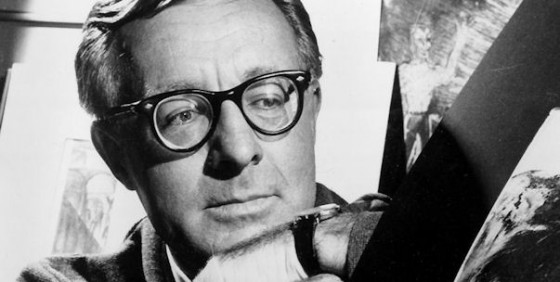
One of the best aspects of people is the way we make writers and artists part of our lives. This week, we lost a great friend and a member of our human family, a person who helped make imagination into reality, who urged us all to make dreams possible.

Writer Ray Bradbury, who died this week at age 91, told tales in such a unique voice and with such simple grace. As I was reading about his life and works this week, I learned that a digital copy of his book, "The Martian Chronicles". was sent to Mars in 2007 aboard the Phoenix spacecraft which landed near the Martian North Pole. And in August of this year, a robotic mission to Mars by a craft named Curiosity will land and many have already suggested the landing site should be called the Ray Bradbury Memorial Station.

His awards and achievements are many. President Obama expressed what many of us thought this week about Ray Bradbury:

"For many Americans, the news of Ray Bradbury's death immediately brought to mind images from his work, imprinted in our minds, often from a young age. His gift for storytelling reshaped our culture and expanded our world. But Ray also understood that our imaginations could be used as a tool for better understanding, a vehicle for change, and an expression of our most cherished values. There is no doubt that Ray will continue to inspire many more generations with his writing, and our thoughts and prayers are with his family and friends."

Back in 2005 when I first began writing this blog, I wrote about my own thoughts about Mars as images of dust devils were filmed by a robotic platform sitting on the planet. I've always liked that post, and in many ways it was my attempt to create something Ray Bradbury would like to read. So, what follows below is a reprint of that post -- and thank you Ray for making our world and our endless sea of stars feel like home.

----

Aug. 23, 2005

MARTIAN


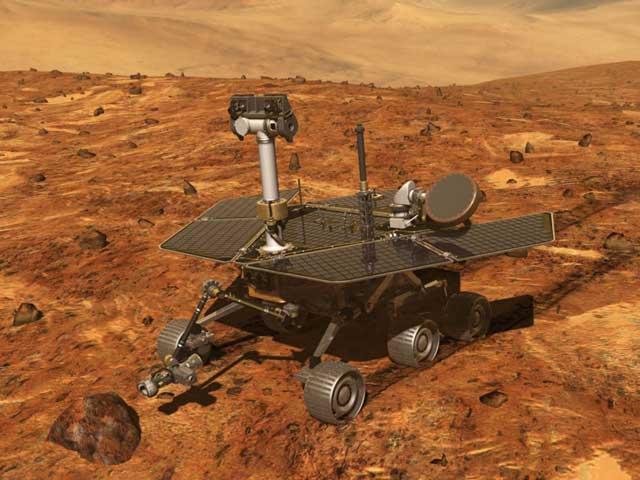
I sit at my computer and I can watch Martian movies, real ones, filmed on location by the first robotic astronauts, mechanical twins roving the desolate reddish landscape for the last year and a half. NASA revealed these images in a short film of just a few seconds, in black and white, robotic cinema verite. I'm pecking at this keyboard on this computer and some 45 million miles away -- Mars will be getting a bit closer these next few months -- and many will mark how this other planet, smaller than the one I call home, takes a slow circular dance around the Sun.

There are no people to see in the short movie, no mulit-limbed invasion squads. The camera filmed in some 12 minutes this passing of "dust devils" across the rocky expanse of Mars which I have sat and watched for maybe a half an hour. It is odd, really, here at this far technological beginning point, this moment and place where I can see what a camera on a remote control cart sees. How long, I wonder, will we Earth-folk take to build and then send other robots to Mars or beyond? In a hundred years, will some other inhabitant of this valley in eastern Tennessee watch robots taking clunky steps to build some empty metal shells that might house fuel or food or other robots? Will it take fifty years or maybe two hundred and fifty?

There have been recent discussions here on this planet about Science and Space and what Science is or should be. Some theories put forth that millions of years ticked past here on this world -- hundreds of millions -- and lifeforms bubbled and swam and clumped together, thanks to the water and the dirt and the air and the fire, and caught hold and started growing. Some theories put forth that a Creator, a Prime Force, made all there is on this planet in six days and rested on the seventh day from that labor. And not only what is on this planet, but everything out in this solar system and beyond it, millions and millions of other galaxies made of planets with fire and ice and gas and shattered meteor bits, and all in six days. It has taken a very very short span of some forty years, 1965 to 2005, for the inhabitants here to begin accept the ideas that inhabitants of other colors or gender might all have the same basic freedoms, another beginning point that is still revolutionary in terms of how we live with each other.

And here I sit, staring at the 17 second movie of dusty twists of wind, ragged white whips that lash back and forth across a desolate world.

Some even more primitive robots have, in less than 30 years, been shot out into the inky blackness which surrounds us, and other planets are photographed -- planets that are thick with heat and pressure, enormous swirling clouds of gas and storms that bring acids and liquid metals in a hazy sheet across a surface whose contents I can barely imagine or conceive. The robot cameras explode or dissolve into nothingness long before they can attain anything even remotely considered a "landing"..

I ponder the Martian landscapes and wonder about it's design -- why create such a place? What purpose does it hold? Were the robotic twins on the scene too soon or too late to catch a sight of intelligent, conscious creatures?


Why make a world of dust? Of ice? 

Perhaps those winds are scattering particles of sand as part of a ten billion year planet renovation plan, and if so I doubt anything left in this valley on my home planet will know about it, even if I wish or hope that someone will be here to see a transformed world.

The Martian world today has little robots staring intently at rocks and dust devils, and people here, too, see it -- observing the location. I seem to understand so little of stars and atoms, I don't understand why the inhabitants here are so contentious and vile, or loving and compassionate in the face of such an enormous collection of galaxies filled with random winds and rotations. I am surprised we have not all stayed hidden in caves, full of fear from moment to moment, like we see it in the beginning of Stanley Kubrick's movie of space travel, "2001: A Space Odyssey". 


But what always excited me watching that movie was that slow, rhythmic rolling dance of men and machines and planets all moving to the Blue Danube Waltz, and how thrilled I was just to see it, to observe this quiet emptiness of space and stars and galaxies whose movements I cannot comprehend. And at the end of "2001" (a title whose name once resonated with an implausible future and now is just part of our past), at the end of the movie the astronaut has been moved from the caves to the stars and Kubrick leaves me to make up my own mind about what I have seen, what it all might mean.

My niece told me some years ago she fell asleep when she watched the movie it was so boring to her. I could hardly believe it. How could anyone watch those images and not feel some kind of un-nameable connection. some sense of endless wonder, some urge to search among the stars?


Filming geologic time will not bring box office dollars.


Mars has been in our books and our imaginations for thousands of years. Once on a Halloween night it escaped from the radio and terrified thousands of radio listeners, and Mars landed on top of actor Tom Cruise this summer. TV gave us "My Favorite Martian", and in ancient days it was the home of Gods and myths barely remembered, and today I sit and watch the dust devils filmed on location, on Mars, with no laugh tracks, no panic in the streets.

Maybe the best way to think of it is as development property -- a slow development, true. But I can almost see it all as part of the view of Our backyard. I have to use my imagination, to consider time and distance and what Life requires or how Life must adapt. I have to be willing to consider so many theories, and if I dismiss the possibilities, then I limit my view and I might as well stay in the caves.

Thursday, May 31, 2012

Congratulations You Graduated, Now Get To Work

It's the season for Advice to the Graduate. We live in a time when those old and reliable models for careers don't work so well (if they ever did) and few will admit that just about everyone who has both failure and success are simply making up their plans as they go along. 

I found a good commencement speech for 2012, from author Neil Gaiman, given to the University of  the Arts in Philadelphia. I liked is because I too have been for decades trying to do what Gaiman encourages: make good art.

I'm unsure if our society wants good art. That's a question I constantly struggle to resolve and really haven't. But like so many others, I keep at it because making art is what I want to do, right down to my bones. I also like Gaiman's thoughts since I too realized a long time ago that their really are no rules, other than the ones we make up, to guide the artist.

The entire transcript and video are here, and you should read all of it. Here are some selections to entice you. (And congratulations to the many classes of 2012 graduates - now go do something.)

"When you start out on a career in the arts you have no idea what you are doing.

This is great. People who know what they are doing know the rules, and know what is possible and impossible. You do not. And you should not. The rules on what is possible and impossible in the arts were made by people who had not tested the bounds of the possible by going beyond them. And you can.

If you don't know it's impossible it's easier to do. And because nobody's done it before, they haven't made up rules to stop anyone doing that again."

---

"I learned to write by writing. I tended to do anything as long as it felt like an adventure, and to stop when it felt like work, which meant that life did not feel like work."

---

"Life is sometimes hard. Things go wrong, in life and in love and in business and in friendship and in health and in all the other ways that life can go wrong. And when things get tough, this is what you should do.

Make good art.

I'm serious. Husband runs off with a politician? Make good art. Leg crushed and then eaten by mutated boa constrictor? Make good art. IRS on your trail? Make good art. Cat exploded? Make good art. Somebody on the Internet thinks what you do is stupid or evil or it's all been done before? Make good art. Probably things will work out somehow, and eventually time will take the sting away, but that doesn't matter. Do what only you do best. Make good art.

Make it on the good days too."

---

"We're in a transitional world right now, if you're in any kind of artistic field, because the nature of distribution is changing, the models by which creators got their work out into the world, and got to keep a roof over their heads and buy sandwiches while they did that, are all changing. I've talked to people at the top of the food chain in publishing, in bookselling, in all those areas, and nobody knows what the landscape will look like two years from now, let alone a decade away. The distribution channels that people had built over the last century or so are in flux for print, for visual artists, for musicians, for creative people of all kinds.

Which is, on the one hand, intimidating, and on the other, immensely liberating. The rules, the assumptions, the now-we're supposed to's of how you get your work seen, and what you do then, are breaking down. The gatekeepers are leaving their gates. You can be as creative as you need to be to get your work seen. YouTube and the web (and whatever comes after YouTube and the web) can give you more people watching than television ever did. The old rules are crumbling and nobody knows what the new rules are.

So make up your own rules."

Tuesday, March 13, 2012

Unwired: The Final Installment of a Non-LiveBlog

This is the Third and final part of an experiment I made to live and work offline and write about my results via a sort of non LiveBlog.  (Part two is here.)

The final installment is below, and I must say that - unsurprisingly - the overall results are deeply boring and uninteresting to most everyone. The life of a writer is a fairly boring thing. I tend to work all alone, though I have often collaborated with a few folks. But mostly my time would be akin to watching paint dry. Thinking, scratching out notes and ideas, re-writing and re-writing again are dull events to observe. It's a far, far more exciting time within my brain of course, an electric-synaptic-orgy of thoughts and actions.

I wondered if my creation and eventual publication of a life lived offline would draw in readers. It has not. Not only am I a solo writer, I am a solo human - never been married, no girlfriend currently, so no spousal/near-spousal dramas or comedies to share; no children to tote from one life-affirming event to another; no financial chicanery or wizardry to recount; no daring recipes of dazzling foods to share (though I often do make a fine and tasty dish, plus there's always a fine cup of coffee close by); and as a solo writer, while I do have so many fascinating and intelligent friends, I don't always share such conversations here on this blog, though I often write about the results of my thoughts after such conversations.

Me
I do act, write, direct and produce several stage shows thru the year - and all those I shamelessly do self-promote here. And since a few (very few) have asked, this post includes a fairly recent picture of my very handsome, lovable self.

But I shall add today to this blog the final entry of my Three Part account of my Offline Experiment. Because, as any writer does, I hope what I write does get read. But in all honesty, the writing and the publishing tend to be most important to one lone person: Me.

Should you read, enjoy and share all 3 parts, dear reader, I thank you greatly. Now on with the show!!

PART 3

DAY EIGHT (continued)

11:38 a.m.

All the presentations of status, actions, events, stats, tweets, posts, results both googled and binged, all texting, messaging, and all the jabs of communication short and long … online I am aware these things will reach an audience of readers, whether one or ten or one thousand. Absent the Web, I’m back to the Old Ways of the Writer – what I’m saying and writing may never be seen by anyone.

So the basic foundation of writing is as it ever was: who is the writer writing for or to? Himself? Future generations which might find the scribbled notebooks (or in this case a reader who decides to search the memory of my lone computer)? The drive to make these sentences has been greatly fueled in the last eight to ten years by the reality that I can publish what I write on a global scale without being a lowly worker for a large or small publishing company, newspaper or any other media owner – I pay for my access to the web, write and publish as I wish, daily, weekly, hourly, and I publish whatever I wish. And I know what I write gets read (according to my stats counter) not only by readers in the U.S., but in Europe, Asia, South America – anywhere the Web exists.

And while it is true that without a publisher my earnings from my writing is limited, there still exists a large opportunity that a sizable paycheck will arrive in the future – a matter of my efforts to promote it, or perhaps someone else who decides to share it, or my skill or luck at saying something which snags the world’s imagination and wallets.

11:56 a.m.
Boop-bedoop-bah-bah … grrrrrrr.


8:20 p.m.

Televised coverage of the celeb arrivals for Oscars’ red carpet is deeply dull. Essentially, the actors and performers all parade past a crowd of mostly publicists, herded like cattle, yet politely, but the celebs seem to have little of note to say or do, aside from wearing clothes and jewelry. So few improve skills are displayed – even being interesting seems to escape them … though is the problem instead that today’s celebs don’t like this parade, even resent it?

9:15 p.m.

Producer Brian Grazer … how old is he, 60? Crazy scientist/spiky 1980’s pop star/anime hair looks odd on old people.

10:00 p.m.

Cirque du Soleil performs a showcase of … well, what was their show about? As the cast swings around the theater I keep thinking about how the producers of the Spiderman show on Broadway should have used them. I still think the backstage is the place to be these days.

So sad that Crystal doesn’t have Jack Nicholson to make jokes about this time around. He does Clooney jokes instead … but the mirth is oddly muffled.

11:30 p.m.

Let’s see – a French silent film comedy filmed in L.A., Meryl Streep as Margaret Thatcher, Woody Allen’s script, black actresses playing maids in the 1960s, a song by the Muppets, and efx/tech awards heaped upon Martin Scorcese … the show tonite seemed steeped in nostalgia.


DAY NINE

8:00 a.m.

I’m cranky and unhappy without the ability to seek and read news from the wide range of sources via the Web. There’s such a superficial gloss, an total lack of critical thinking and a loving embrace of the spin from PR men and women on television.

9:00 a.m.

This offline experiment is a drag so I am ending it. However, I will extend it through today so that I might prepare some closing remarks … which hopefully will contain some kind of notable conclusion. Hopefully. Right now, I’m lacking any wisdom here, other than I am suffering a debilitating addiction to the internet. Does that make me pitiable or do I have merely a ‘first world problem’?

I’ve cleared more than a week without it, approaching 10 days. What time period is needed to truly flush my system of digital cyber-toxins? A month? A year? Or is it like alcohol or drug addiction – meaning I am forever an addict forced to live one day at a time with the constant threat that the addiction will return with even the slightest usage, just one email is all it would take and boom! I’m over the edge of the abyss.

How long could you go without the online world, dear reader? An hour? A day? Do you dare even attempt it?

1:00 p.m.

Grim hours ahead as I cling to my experiment in spite of a raging urge to go online …

Perhaps what has been absent is more than just my ability to amuse, entertain or even educate myself via the Web … perhaps the removal of access is also the removal of my one constant avenue of self-expression in our modern world. No access means no voice for me about the world I inhabit? That’s a chilling thought …

DAY ELEVEN

I'm going back online tomorrow .... what have I learned, if anything, trying this offline experiment? That, dear reader, is a question I will have to ponder .... and yet I wonder most -- how long could you go with no online access??

Thursday, March 03, 2011

Philip K. Dick's Dystopian World Taking Over?


"Because today we live in a society in which spurious realities are manufactured by the media, by governments, by big corporations, by religious groups, political groups...So I ask, in my writing, What is real? Because unceasingly we are bombarded with pseudo-realities manufactured by very sophisticated people using very sophisticated electronic mechanisms. I do not distrust their motives; I distrust their power. They have a lot of it. And it is an astonishing power: that of creating whole universes, universes of the mind."


It should not be surprising - but it is - that we seem to be truly inhabiting the dystopian world envisioned by science fiction writer Philip K. Dick. His works explored perception, reality, paranoia, corporate worship, identity, computer technologies, constant surveillance, the mass marketing of tragedy, an emerging global polyglot society and so much more which seems to resonate so strongly with generation after generation. And today his ideas serve as a rich and fertile field for cultural exploration.

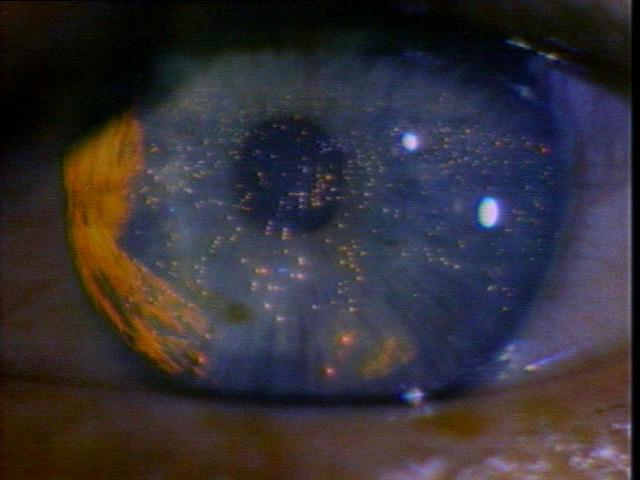
Reports are flying today of the rights being secured to create sequels and prequels a TV series and maybe a remake of the movie "Blade Runner" - which already exists as a 5-disc movie collection on DVD with all variant versions and documentaries. Producers seem to be aiming at creating movies within the world created in Ridley Scott's movie -- and already there are 3 novels based in the BR world from writer K.W. Jeter. And the Total Recall 2010 TV series also blended that movie and Total Recall (based on another PKD story) into a short-lived and rather awful TV show.

Really what they are aiming at is franchising writer Philip K Dick, whose works constitute nearly an industry unto themselves - witness this weekend's arrival of "The Adjustment Bureau" based on PKD's short story. an independent film of his novel "Radio Free Albemuth" is seeking a distributor, Disney has an animated feature in production based on "The King of the Elves", and apparently two films called "The Owl In Daylight", one a documentary, are being created as well. A look at 9 of the movies made based on his work so far is here.

Largely regarded as one of his best works, the alternate history of the world wherein the Allies lost World War 2, "The Man In The High Castle", is in production as a mini-series on BBC, spearheaded by Ridley Scott.

The number of new books, festivals, new films, music, and new collections of his work is so large it's more than impossible to list.

I've always enjoyed reading his work (and some of the movies) but I was always left with the great hope that little of his perceived futures would come to pass. He wrote of society endlessly deceived and deluded and controlled by great wealth and nefarious leaders, a hopeless and helpless humanity, yet one in which he searched for hope.

Some years back, a project was launched to create a functioning android with artificial intelligence was created using a model of Dick's face and speech patterns. It was beyond spooky and got stranger still when the head of this android was accidentally lost and went traveling via airplane to California.

The creators were adamant however and now are presenting their creation again, though work is still to be completed for creating an artificial intelligence for the android. A video sample of the PKD2 is quite surreal.

"
Dick's fiction calls up our basic cultural assumptions, requires us to reexamine them, and points out the destructive destinations to which they are carrying us. The American Dream may have succeeded as a means of survival in the wilderness of early America; it allowed us to subdue that wilderness and build our holy cities of materialism. But now, the images in Dick's fiction declare, we live in a new kind of wilderness, a wasteland wilderness, because those cities and the culture that built them are in decay. We need a new American dream to overcome this wasteland."
  • Patricia S. Warrick, Mind in Motion: The Fiction of Philip K. Dick (1987)

Tuesday, December 28, 2010

2010: The Year At Your Cup of Joe


A quick look back at 2010 through a blog filter --

While recently reading through the information about those who visit and read here often, I learned that in 2010 this blog had landed on a site which declares Cup of Joe P. to be in the top 5 best political blogs in the country. And yes, that's certainly an wise observation. The reason, according to the writer(s) is that I am apparently the lone liberal in Tennessee pushing out political posts. Quote: "
The political experience of supporting the extremely minor party in what's essentially a single-party state is compelling." Which is not true. I think there's at least five of us here in Tennessee who write something other than the usual political hype.

But I won't link to the site that says this, as my browser advises me the site has a dubious quality (meaning it's probably a site full of malware) and it has the odd, odd title of 'guide to online schools' and seems, though flattering to me, just a strange aggregator of hackerish infamy.

A more reputable bit of praise came in 2010 from Knoxville's Metro Pulse newspaper, marking me as being a site worth bookmarking and reading, though they also noted I was somewhat of an 'old-fashioned' thing, a blog, while the modern now-a-go-go kids all Twitter instead. You know I've always hated the word blog but twitter sounds even sillier. I thank MP for the mention, though in truth, Knoxville-centered sites like the News Sentinel's No Silence Here and R. Neal's KnoxViews have been consistently supporting my work here since just about day one. Welcome to the Cup of Joe party, MP.

Of course, my family continues to look at me with a hairy eyeball since I do not earn big bucks with this page. Not that they ever read this page. My family has generally been supportive of my creative efforts since I made it my profession some 25 years ago, but they think I'm ten kinds of crazy to continue writing as I haven't made tons of income nor tons of fame and I admit I often have to look anywhere and everywhere for other ways to make money. (Pleasing family is hard/impossible.) And 2010 was a horrible year for writing work. Newspapers, magazines, online web sites and other places where I have usually made decent money all shut down their programs of paying for freelance writing. And then there was another writing job I took this year where someone else got all the credit for writing it. Thanks for the ego kick.

Writers just don't get much respect - even those who make big bucks have to wade through derisive assessments of their work (regardless of the quality). Here's a way of looking at this situation -- let's say you have need of a plumber, or attorney, or mechanic or consultant or etc. etc at your home or office. If you contact that professional you know, you know, that you will have to pay a fee just for getting them to examine your problem, then there is a steep hourly fee for work they do. But a writer - we work first, submit the work for someone to approve and only if said someone likes it will you get paid. And you don't get paid by the hour. They offer pennies per word. If I told the folks who ask me to write something that there is a non-refundable fee just for considering their request I would be brushed aside like some funny smelling leftover in the fridge.

And really, I knew since I started putting my writing efforts online, for anyone to read for free, that while I was bypassing all the kings who control publishing, I was going to have to endure long waits for a payoff. So be it. Great satisfaction arrives as I see that readers from such places as Great Britain, France, India, China, Australia, Chile, Morocco, and on and on, land on this page and read something I've written.

I don't feel bitter, even if a touch of bitterness is discernible in these words. I knew long, long ago this compulsion to write was a personal thing. And I have learned over the decades that I can (and so I do) demand certain levels of compensation and fees for my work. Especially if you seek me out to write something for you to use. The way I see it, such demands should make us both feel good that we are working for something of a higher quality.

(Now back to the topic proper)

In 2010, some of the posts which brought the most readers (note: while there were many posts which were of a serious nature and/or garnered state and national attention, it seems the odd and offbeat items I comment on are usually the top draws for visitors):

-- This post on Iran's legal/religious perspective on a mullet haircut was quite popular (especially since Instapundit and Pajamas Media made mention of it).

-- A consistent hit among Google searches this year came from this 2009 post wherein a theory is presented by comedian John Hodgman that President Obama is somehow linked to the fictional 'Kwisatz Haderach" from the Dune books by Frank Herbert and the tale wins my own personal award for Weird Political Delusions in a most delusional political year.

-- Cows invading a home also brought many thousands upon thousands of visitors, as is proper, it seems to me, when cows invade.

-- My favorite item here on this page is not my own creation - but this video, wherein doodles and flipbooks craft the vast tale from creation to the present day still amuses me greatly.


Meanwhile, here are a few other items from TN bloggers as they review the year 2010 -

Southern Beale has her take on the best in books/movies/music of 2010.

Newscoma is celebrating her 5th year of blogging (and really, I am working on finding another word besides "blog" to categorize the online writers/writing I am part of).

News stories, politics and more which held attention in 2010 at KnoxViews is presented here.

SEE ALSO: Google has compiled the info on the most popular searches on their system for 2010. The World Cup was the big winner, followed by disasters from around the world.

And here's to you, dear readers, for making a habit to visit and return often. I wish you each and everyone the very best 2011 possible.

Wednesday, April 14, 2010

Spring Is Here and Where Am I?

It's a rather disjointed day, what with the sun blazing like Love itself overhead and every green thing growing so fast you can almost hear it, and every thing that crawls or flies or burrows or sings or runs or talks or barks or purrs or swims or that just moseys from here to there amid all those bright Spring colors. It's all disjointed because here I am basking in all that Life and I am utterly perplexed, bewildered and snarled up from the inside out.

I can give a name to all these joyous and marvelous things so abundant all about me - but in my head and in my thoughts, something else is moseying about, something I can't really name at all. As a constant writer, such a lacking is deeply uncomfortable.

In this wee digital space I've made with this blog, and even in those long-ago times when I scratched across some bit of actual paper with a pen or pencil, I do the one thing I've always done: I write.

I happened across a proverb today which says "Any day you can wake up and put on your pants is a good day." That seems to set a notably low bar for a good day, though if one were unable to a) wake up, b) dress themselves, c) have any clothes or bed or to even experience a period of sleep, then the elements of the proverb might seem rich beyond measure.

I spoke with a friend today and he mentioned I might perhaps have some kind of 'writer's arthritis' or something. Maybe so. Maybe it's a stiffness, a lack of flexibility or something minor.

If -- or perhaps I should say "when" - someone tells me I am a bad writer, I think to myself (with no humility) "oooh, he called me a writer."

Or as Kurt Vonnegut Jr. once wrote: "
The primary benefit of practicing any art, whether well or badly, is that it enables one's soul to grow."


So maybe it's just Springtime in my writing mind and who knows what might grow from it?


Tuesday, December 01, 2009

Cormac's Knoxville Typewriter Being Auctioned


Christie's will auction an Olivetti Lettera 32 portable typewriter on Friday - the very typewriter which writer Cormac McCarthy bought in Knoxville at a pawn shop in the early 1960s, the one McCarthy has used ever since, pouring his thoughts and words through the device for the last 50 years.

He says in this NYTimes story, "No Country For Old Typewriters", that every book he's ever written was made with that Olivetti. From the early days of usage by writers through to today's digital writing programs, writers and those who observe them eyed the typewriter as a mystery:

"
He remembers one summer when some graduate students were visiting the Santa Fe Institute. 'I was in my office clacking away,' he said. 'One student peered in and said: ‘Excuse me. What is that?’ ”

Glenn Horowitz, a rare-book dealer who is handling the auction for Mr. McCarthy, said: “When I grasped that some of the most complex, almost otherworldly fiction of the postwar era was composed on such a simple, functional, frail-looking machine, it conferred a sort of talismanic quality to Cormac’s typewriter. It’s as if Mount Rushmore was carved with a Swiss Army knife.”

The Olivetti was held in high regard as an art form itself. The Museum of Modern Art focused on the Olivetti in an exhibit in 1952, while the French put together a touring art exhibit devoted to it in the late 1960s.

Is it the power of words or the skills of the writer which captures the imagination so?

A 2007 book, "The Iron Whim: A Fragmented History of Typewriting", author Darren Wershler-Henry writes how the device was used by the likes of Nietzsche and that Mark Twain was the first major writer to turn into publishers a typewritten manuscript. And he offers up some prose of his own to evoke the imagination:

"
The typewriter has become the symbol of a non-existent sepia-toned era when people typed passionately late into the night under the flickering light of a single naked bulb, sleeves rolled up, suspenders hanging down, lighting each new cigarette off the smouldering butt of the last, occasionally taking a pull from the bottle of bourbon in the bottom drawer of the filing cabinet."

Yeah, but those things were very loud, pounding out words meant making sounds like a World War 2 anti-aircraft gun. The sound was so well-known that it had it's own song, was used as percussion in Dolly Parton's "9 to 5" song, and once was the universal sound of a working newsroom or busy office, and even a comedy routine by Jerry Lewis.

Christie's says McCarthy's machine should bring about $15-20,000. Good money for any writer.

Thursday, February 26, 2009

In Celebration of Philip Jose Farmer


One of the most imaginative American writers of science fiction, Philip Jose Farmer, passed away yesterday at the age of 91 and I gladly write today to celebrate his life and his work.

Sly and witty, dangerous and ambitious, fearless and playful, he was a most notable influence on the genre and was certainly a major influence for me as well. He might be best known to many readers as the author of the Riverworld series, but he was quite prolific, penning novels, short stories, essays, fictional biographies and much more. He won several Hugo awards and earned Lifetime Achievement awards too.

He could concoct astonishing worlds and galaxies, such as in the World of Tiers series of novels, or quirky futures, as in his award-winning short story "Riders of the Purple Wage", which surely forecast many of the elements and issues our society experiences today -- as WikiPedia notes of that story, it is:

"
... an extrapolation of today's tendency towards state supervision and consumer-oriented economic planning. In the story, all citizens receive a salary (the purple wage) from the government, to which everyone is entitled just by being born. The population is self-segregated into relatively small communities, with a controlled environment, and keeps in contact with the rest of the world through the Fido, a combination television and videophone."

Sounds like our economically lost and internet-addicted world today.

His characters were often participants in unbridled sexual behavior, and he also wrote numerous books about famous fictional heroes which proclaimed they were all real - Tarzan, Doc Savage, Phineas Fogg, the Shadow, Sherlock Holmes and many more. He gained some infamy for publishing a book under the name of Kilgore Trout, the

fictional science-fiction scribe featured in several books by Kurt Vonnegut Jr. The book, "Venus on the Half-Shell", was rude and raunchy and hilarious, much as Vonnegut described that author, though Vonnegut did indeed tell Farmer to not create any more books by Trout. Too real perhaps?

In his Riverworld series, he brought out famous and infamous figures from throughout human history, from Mark Twain to Jack London and Tom Mix, together for a raucous adventure in the afterlife.

Another element of his storytelling I always enjoyed was how he placed himself in his stories. In the World of Tiers series, for example, he included the character of Paul Janus Finnegan (initials are PJF), aka Kickaha.

(Also see this novel for more.)

While his work was always immensely detailed and creative, he made sure his work also created a tremendously fun time for the reader.

Thanks for all the fine times, Phil. You made the journey fun and stoked the fires of imagination for many of us. Rest In Peace -- or better perhaps to say, "Hope the next adventure never ends."

Saturday, October 11, 2008

The Hell of Nightclubs

Back in the ancient days of my twenties, I would often be a trooper and join some horde headed to a nightclub. It would not take long after being rubber-stamped or enduring other various entry rituals that I would begin mentally writing a story about how god-awful the place and the people were.

I do (did) enjoy dancing or drinking with friends, but these days if I dance, it's mostly a scene of comedic horror, though there is some joy to be taken in watching others audition for their own starring roles in similar movies. I have seen and taken part in karaoke clubbing too ... clubbing is indeed the active word for such things. The last time I was in such a gathering, I had been hoodwinked into "judging" a karaoke contest and for the most part, I imagine the event would be comparable to going to a dangerous intersection late at night and waiting for a brutal car crash.

Over the years, I have tried numerous times to actually finish a fictional take on the Hell that is a nightclub, with no success. However, I did happen to read a short and visceral take on clubbing from British pop culture critic Charlie Brooker which is a bona fide beauty of language and writing.

Some samples:

"
Clubs are despicable. Cramped, overpriced furnaces with sticky walls and the latest idiot theme tunes thumping through the humid air so loud you can't hold a conversation, just bellow inanities at megaphone-level. And since the smoking ban, the masking aroma of cigarette smoke has been replaced by the overbearing stench of crotch sweat and hair wax.

Clubs are such insufferable dungeons of misery, the inmates have to take mood-altering substances to make their ordeal seem halfway tolerable. This leads them to believe they "enjoy" clubbing. They don't. No one does. They just enjoy drugs."

---

"The second thing that struck me was frightening. They were all photographing themselves. In fact, that's all they seemed to be doing. Standing around in expensive clothes, snapping away with phones and cameras. One pose after another, as though they needed to prove their own existence, right there, in the moment. Crucially, this seemed to be the reason they were there in the first place. There was very little dancing. Just pouting and flashbulbs.

Surely this is a new development. Clubs have always been vapid and awful and boring and blah - but I can't remember clubbers documenting their every moment before. Not to this demented extent. It's not enough to pretend you're having fun in the club any more - you've got to pretend you're having fun in your Flickr gallery, and your friends' Flickr galleries. An unending exhibition in which a million terrified, try-too-hard imbeciles attempt to out-cool each other.


Read the whole thing here. (Also check out Brooker's properly disdainful sneering headshot image.)

Monday, August 04, 2008

Thoughts on Alexander Solzhenitsyn


Sometime in 1974, I was lugging around this gigantic book with the weird name of "The Gulag Archipelago".

Fortunately, living in a small town on the Cumberland Plateau, the title was just a bit too strange and the author's name, Alexander Solzhenitsyn, too foreign, to cause any curious person to dare ask me what that book was about. Carrying that book around for the months it took me to read it, I could see so many folks just filing away information about me - that is a one strange boy, their eyes said.

I was strange. Still am, really.

But that book got etched into my mind. Ostensibly a chronicle of life in a prison camp in the former Soviet Union, it is so much more. It is a marvel of writing, sometimes deeply personal, sometimes darkly comic, wrapped in politics and madness, attempting to grasp the utter dehumanization of the individual and the society which was ingrained into the lives of not just a nation, but the world in general.

I learned that tyranny and terror were incredibly powerful tools which could warp the thoughts and actions, sometimes with colossal bluntness, sometimes with precise skill. Could anyone survive the systematic insanity the police state created?

Around the time of the book's publication, Solzhenitsyn's face was often in the news. His long beard made him look like a relic of the both the recent and the ancient past. His views, so often expressed through the prism of his political ponderings, were difficult to decipher. He wasn't willing to play the part the media had made for him, The Dissident. Eventually, he faded into the background.

I was sad to read of his death - he had lived in the U.S. in his own style of personal exile. He continued to write, but his books were hardly best-sellers anymore. The comments and the posting on Gawker, for example, are as obtuse and odd. While he might have been able to capture the effects of a world gone mad, the world never knew what to make of him.

His account of life and politics in the Gulag trilogy are among the great works of the last century. Reading the books will still challenge and startle and inspire. Perhaps that was the best he could have hoped for.

Thursday, April 12, 2007

Goodbye, Methuselah, or Poo-Tee-Weet!

All around the world and especially in America people on this day will be writing to mourn and celebrate Kurt Vonnegut Jr who died yesterday at age 84. I'll bet cash money that the majority of writers today were inspired to write because of Vonnegut. I know I was.

I can recall with much clarity the day I picked up "Breakfast of Champions" in a bookstore in the old 100 Oaks Mall in Nashville in the mid-1970s, read the first page and fell in love with the book and the writer. It broke every rule I had been taught about writing in school and was one of the most powerful tales I've ever read. That book showed me that what I needed to do to be a writer was to believe in whatever writing voice I had, and to love my readers and my characters and to be honest with them and with myself. The rest would take care of itself.

Vonnegut was the best writing teacher I ever had, though we only met each other on the pages he penned. I got drunk on those pages, lost time, got dizzy, and would lift up my eyes from the page and look around to see if anyone had noticed that I had left the world and been ... somewhere else.

I remain astonished at how he could be simple and profound and silly and say so much is seemingly small ways. Little phrases have always stayed with me - So it goes ... diddley-squat ... chrono-synclastic infidibulum .... rented a tent a tent a tent ....

Vonnegut would occassionally provide commencement speeches for college graduations. Here is one he gave to grads at Rice University:

"
Have we met before? No. But I have thought a lot about people like you. You men here are Adam. You women are Eve. Who hasn't thought a lot about Adam and Eve?

This is Eden, and you're about to be kicked out. Why? You ate the knowledge apple. It's in your tummies now.

And who am I? I used to be Adam. But now I am Methuselah.

And who is a serpent among us? Anyone who would strike a child.

So what does this Methuselah have to say to you, since he has lived so long? I'll pass on to you what another Methuselah said to me. He's Joe Heller, author, as you know, of Catch 22. We were at a party thrown by a multi-billionaire out on Long Island, and I said, ''Joe, how does it make you feel to realize that only yesterday our host probably made more money than Catch 22, one of the most popular books of all time, has grossed world-wide over the past forty years?''

Joe said to me, ''I have something he can never have.''

I said, ''What's that, Joe?''

And he said, ''The knowledge that I've got enough.''

.....

"Mark Twain, at the end of a profoundly meaningful life, for which he never received a Nobel Prize, asked himself what it was we all lived for. He came up with six words which satisfied him. They satisfy me, too. They should satisfy you:

''The good opinion of our neighbors.''

Neighbors are people who know you, can see you, can talk to you -- to whom you may have been of some help or beneficial stimulation. They are not nearly as numerous as the fans, say, of Madonna or Michael Jordan.

To earn their good opinions, you should apply the special skills you have learned here, and meet the standards of decency and honor and fair play set by exemplary books and elders.

It's even money that one of you will get a Nobel Prize. Wanna bet? It's only a million bucks, but what the heck. That's better than a sharp stick in the eye, as the saying goes.

This speech is now almost twice as long as the most efficient oration ever uttered by an American: Abraham Lincoln's Gettysburg Address. Lincoln was murdered for his ideals. The founder of this university, William Marsh Rice, another idealist, was murdered for his money. Whatever! The good both men did lives after them.

Up to this point this speech has been new stuff, written for this place and this occasion. But every graduation address I've delivered has ended, and this one will, too, with old stuff about my Uncle Alex, my father's kid brother. A Harvard graduate, Alex Vonnegut was locally useful in Indianapolis as an honest insurance agent. He was also well-read and wise.

One thing which Uncle Alex found objectionable about human beings was that they seldom took time out to notice when they were happy. He himself did his best to acknowledge it when times were sweet. We could be drinking lemonade in the shade of an apple tree in the summertime, and he would interrupt the conversation to say, "If this isn't nice, what is?"

So, I hope that you Adams and Eves in front of me will do the same for the rest of your lives. When things are going sweetly and peacefully, please pause a moment, and then say out loud: ''If this isn't nice, what is?'' Hold up your hands if you promise to do that.

That's one favor I've asked of you.

Now I ask you for another one. I ask it not only of the graduates, but of everyone here, including even Malcolm Gillis, so keep your eyes on him. I'll want a show of hands, after I ask this question:

''How many of you have had a teacher at any level in your educations who made you more excited to be alive, prouder to be alive, than you had previously believed possible?''

Hold up your hands, please.

Now take down your hands and say the name of that teacher to someone sitting or standing near you.

All done? Thank you.

If this isn't nice, what is?