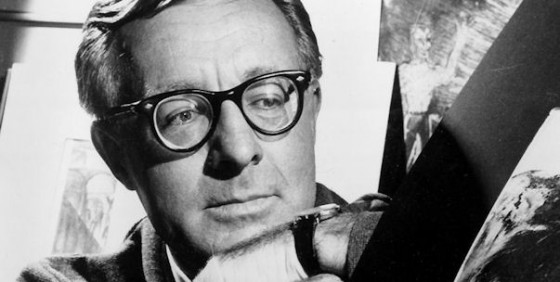
One of the best aspects of people is the way we make writers and artists part of our lives. This week, we lost a great friend and a member of our human family, a person who helped make imagination into reality, who urged us all to make dreams possible.
 Writer Ray Bradbury, who died this week at age 91, told tales in such a unique voice and with such simple grace. As I was reading about his life and works this week, I learned that a digital copy of his book, "The Martian Chronicles". was sent to Mars in 2007 aboard the Phoenix spacecraft which landed near the Martian North Pole. And in August of this year, a robotic mission to Mars by a craft named Curiosity will land and many have already suggested the landing site should be called the Ray Bradbury Memorial Station.
His awards and achievements are many. President Obama expressed what many of us thought this week about Ray Bradbury:
Writer Ray Bradbury, who died this week at age 91, told tales in such a unique voice and with such simple grace. As I was reading about his life and works this week, I learned that a digital copy of his book, "The Martian Chronicles". was sent to Mars in 2007 aboard the Phoenix spacecraft which landed near the Martian North Pole. And in August of this year, a robotic mission to Mars by a craft named Curiosity will land and many have already suggested the landing site should be called the Ray Bradbury Memorial Station.
His awards and achievements are many. President Obama expressed what many of us thought this week about Ray Bradbury:
"For many Americans, the news of Ray Bradbury's death immediately brought
to mind images from his work, imprinted in our minds, often from a
young age. His gift for storytelling reshaped our culture and expanded
our world. But Ray also understood that our imaginations could be used
as a tool for better understanding, a vehicle for change, and an
expression of our most cherished values. There is no doubt that Ray will
continue to inspire many more generations with his writing, and our
thoughts and prayers are with his family and friends."
Back in 2005 when I first began writing this blog, I wrote about my own thoughts about Mars as images of dust devils were filmed by a robotic platform sitting on the planet. I've always liked that post, and in many ways it was my attempt to create something Ray Bradbury would like to read. So, what follows below is a reprint of that post -- and thank you Ray for making our world and our endless sea of stars feel like home.
----
Aug. 23, 2005
MARTIAN
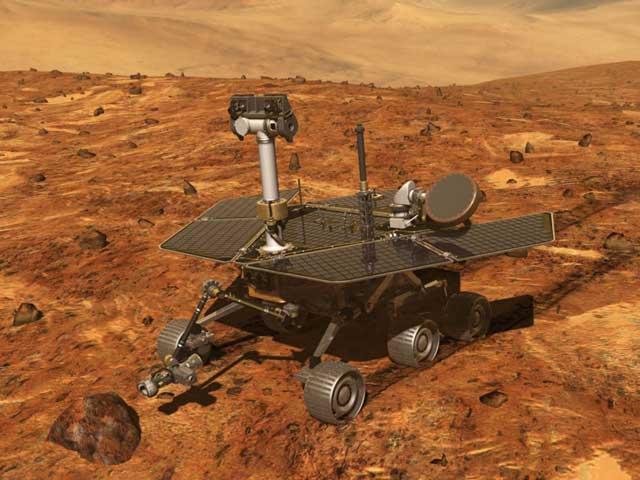
I sit at my computer and I can watch
Martian movies, real ones, filmed on location by the first robotic
astronauts, mechanical twins roving the desolate reddish landscape for
the last year and a half. NASA revealed these images in a short film of just a few seconds,
in black and white, robotic cinema verite. I'm pecking at this keyboard
on this computer and some 45 million miles away -- Mars will be getting
a bit closer these next few months -- and many will mark how this other
planet, smaller than the one I call home, takes a slow circular dance
around the Sun.
There are no people to see in the short movie, no
mulit-limbed invasion squads. The camera filmed in some 12 minutes this
passing of "dust devils" across the rocky expanse of Mars which I have
sat and watched for maybe a half an hour. It is odd, really, here at
this far technological beginning point, this moment and place where I
can see what a camera on a remote control cart sees. How long, I wonder,
will we Earth-folk take to build and then send other robots to Mars or
beyond? In a hundred years, will some other inhabitant of this valley in
eastern Tennessee watch robots taking clunky steps to build some empty
metal shells that might house fuel or food or other robots? Will it take
fifty years or maybe two hundred and fifty?
There have been
recent discussions here on this planet about Science and Space and what
Science is or should be. Some theories put forth that millions of years
ticked past here on this world -- hundreds of millions -- and lifeforms
bubbled and swam and clumped together, thanks to the water and the dirt
and the air and the fire, and caught hold and started growing. Some
theories put forth that a Creator, a Prime Force, made all there is on
this planet in six days and rested on the seventh day from that labor.
And not only what is on this planet, but everything out in this solar
system and beyond it, millions and millions of other galaxies made of
planets with fire and ice and gas and shattered meteor bits, and all in
six days. It has taken a very very short span of some forty years, 1965
to 2005, for the inhabitants here to begin accept the ideas that
inhabitants of other colors or gender might all have the same basic
freedoms, another beginning point that is still revolutionary in terms
of how we live with each other.
And here I sit, staring at the 17
second movie of dusty twists of wind, ragged white whips that lash back
and forth across a desolate world.
Some even more primitive
robots have, in less than 30 years, been shot out into the inky
blackness which surrounds us, and other planets are photographed --
planets that are thick with heat and pressure, enormous swirling clouds
of gas and storms that bring acids and liquid metals in a hazy sheet
across a surface whose contents I can barely imagine or conceive. The
robot cameras explode or dissolve into nothingness long before they can
attain anything even remotely considered a "landing"..
I ponder
the Martian landscapes and wonder about it's design -- why create such a
place? What purpose does it hold? Were the robotic twins on the scene
too soon or too late to catch a sight of intelligent, conscious
creatures?
Why make a world of dust? Of ice?
Perhaps those winds are scattering
particles of sand as part of a ten billion year planet renovation plan,
and if so I doubt anything left in this valley on my home planet will
know about it, even if I wish or hope that someone will be here to see a
transformed world.
The Martian world today has little robots
staring intently at rocks and dust devils, and people here, too, see it
-- observing the location. I seem to understand so little of stars and
atoms, I don't understand why the inhabitants here are so contentious
and vile, or loving and compassionate in the face of such an enormous
collection of galaxies filled with random winds and rotations. I am
surprised we have not all stayed hidden in caves, full of fear from
moment to moment, like we see it in the beginning of Stanley Kubrick's
movie of space travel, "2001: A Space Odyssey".
But what always excited me watching
that movie was that slow, rhythmic rolling dance of men and machines and
planets all moving to the Blue Danube Waltz, and how thrilled I was
just to see it, to observe this quiet emptiness of space and stars and
galaxies whose movements I cannot comprehend. And at the end of "2001"
(a title whose name once resonated with an implausible future and now is
just part of our past), at the end of the movie the astronaut has been
moved from the caves to the stars and Kubrick leaves me to make up my
own mind about what I have seen, what it all might mean.
My niece
told me some years ago she fell asleep when she watched the movie it
was so boring to her. I could hardly believe it. How could anyone watch
those images and not feel some kind of un-nameable connection. some
sense of endless wonder, some urge to search among the stars?
Filming geologic time will not bring box office dollars.
Mars has been in our books and our
imaginations for thousands of years. Once on a Halloween night it
escaped from the radio and terrified thousands of radio listeners, and
Mars landed on top of actor Tom Cruise this summer. TV gave us "My
Favorite Martian", and in ancient days it was the home of Gods and myths
barely remembered, and today I sit and watch the dust devils filmed on
location, on Mars, with no laugh tracks, no panic in the streets.
Maybe
the best way to think of it is as development property -- a slow
development, true. But I can almost see it all as part of the view of
Our backyard. I have to use my imagination, to consider time and
distance and what Life requires or how Life must adapt. I have to be
willing to consider so many theories, and if I dismiss the
possibilities, then I limit my view and I might as well stay in the
caves.