
Showing posts with label outer space. Show all posts
Showing posts with label outer space. Show all posts
Saturday, June 03, 2017
Breezes of Heaven
Jupiter: Juno Perijove 06 from Sean Doran on Vimeo.
"As soon as somebody demonstrates the art of flying, settlers from our species of man will not be lacking on the moon and Jupiter... Given ships or sails adapted to the breezes of heaven, there will be those who will not shrink from even that vast expanse." -- Ovid
Cyclones as big as the planet Mars - dozens of them - cover the poles of the planet Jupiter. A spacecraft named for the mythical Jupiter's wife, Juno, has traveled the 300 million plus miles and is capturing the best images yet of this giant planet.
Here on Earth, we have observed and studied Jupiter for thousands of years, and we've never had such astounding images or detailed measurements.
More on the mission itself here.


Friday, August 28, 2015
A Decade of Writing on the Web
I've been so busy I missed my own blog birthday - 10 years are done and I'm now on Year 11. Yay me.
Obviously The Regular Reader knows the posts here have been intermittent in the last year or so, but that's changing as a few new adventures are compelling me to become more prolific here. Details on that will follow very soon.
When I began this page, the Web was exploding with blogs, and many of those are now kaput. I am not kaput. That noisy proliferation has now turned into a far more vast cacophony of voices and images which get Tweeted and Pinterested and Instagrammed and Facebooked and far more names of platforms being created. I'm a long-form writer who abhors brevity. Except when I don't.
And still, our world is only just inside the doorway of what is possible with the Internet. If the Internet is the New Alphabet then we've only gotten 3 or 4 letters figured out. More is to be discovered and the new combinations possible are far too large to even imagine ... so far.
When I was a wee boy, knowing down in my bones that I wanted to be a writer, I think I saw a Writer as a process that ended with being a Good Writer Who Writes. Now these many years later, I see it's a process of creation that never ends.
What's been the best writing here? The most popular?
The Google stats say "Dr. Evil Running Congress?" has been the most viewed post, with over 22,000 views is Most Popular, but that's likely because the image I used of Dr. Evil became a hot listing via image searches using Google. Also popular, pretty much all posts about Frightmare Manor, the haunted attraction located just down the street, have been huge hits on the Web. And they are getting ready to open up again for 2015.
I have various favorites, but here are two posts that I rank as my own best.
First, "Martian", a rumination on the planet Mars and the robots we've placed there. It's from the very first weeks of publishing, and I really like it. In fact, other than movies, I've probably written the most about my fascination with our universe, our solar system and how we do and do not explore it.
My next favorite is also from the early days, "Would You Like To Hear Some Stories?", a post prompted by my sister-in-law and the very real and astonishing experiences of her family during World War 2 and how the posting of those events led to the discovery after many decades of what happened to Katherine's mother's cousin, revealed in the comments of that post.
Obviously The Regular Reader knows the posts here have been intermittent in the last year or so, but that's changing as a few new adventures are compelling me to become more prolific here. Details on that will follow very soon.
When I began this page, the Web was exploding with blogs, and many of those are now kaput. I am not kaput. That noisy proliferation has now turned into a far more vast cacophony of voices and images which get Tweeted and Pinterested and Instagrammed and Facebooked and far more names of platforms being created. I'm a long-form writer who abhors brevity. Except when I don't.
And still, our world is only just inside the doorway of what is possible with the Internet. If the Internet is the New Alphabet then we've only gotten 3 or 4 letters figured out. More is to be discovered and the new combinations possible are far too large to even imagine ... so far.
When I was a wee boy, knowing down in my bones that I wanted to be a writer, I think I saw a Writer as a process that ended with being a Good Writer Who Writes. Now these many years later, I see it's a process of creation that never ends.
What's been the best writing here? The most popular?
The Google stats say "Dr. Evil Running Congress?" has been the most viewed post, with over 22,000 views is Most Popular, but that's likely because the image I used of Dr. Evil became a hot listing via image searches using Google. Also popular, pretty much all posts about Frightmare Manor, the haunted attraction located just down the street, have been huge hits on the Web. And they are getting ready to open up again for 2015.
I have various favorites, but here are two posts that I rank as my own best.
First, "Martian", a rumination on the planet Mars and the robots we've placed there. It's from the very first weeks of publishing, and I really like it. In fact, other than movies, I've probably written the most about my fascination with our universe, our solar system and how we do and do not explore it.
My next favorite is also from the early days, "Would You Like To Hear Some Stories?", a post prompted by my sister-in-law and the very real and astonishing experiences of her family during World War 2 and how the posting of those events led to the discovery after many decades of what happened to Katherine's mother's cousin, revealed in the comments of that post.
Tuesday, July 14, 2015
The Last Neighbor - Pluto

If you have more than 3 moons you're a planet in my book, but Pluto is what it is - a wee dwarf planet. It looks huge in the pictures now coming in from NASA's New Horizons spacecraft. (Great links to the mission via KnoxViews, where Randy notes "It will take 16 months to download all the data and images collected by the probe... At 3 billion miles away, it takes 4.5 hours for signals to reach Earth.)

There is a human fondness for the wee world.
It's also essentially our last neighbor here in this Solar neighborhood, and beyond it we see an infinity of galaxies and neighborhoods - and our little neighborhood appears very small.
Tuesday, August 07, 2012
Tennessee Designers Make Mars Rover Move
It's deeply gratifying to learn that some very smart folks in Ooltewah, Tennessee are responsible for making the massive, newly-landed mobile laboratory on the surface of Mars actually move around.
The American Bicycle Group in Ooltewah (population: 687) designed the legs to withstand to the landing and be able to move around the surface for the next several years, according to the story in today's TimesFreePress:
"The Chattanooga team left its mark on Mars, too. Each one of their names
is etched inside the legs they helped create that have now found a
permanent home among the stars."
As this new hallmark in robotic space exploration made it's landing, some thousands of folks gathered to watch it all live on the giant screen in Times Square. (click to enlarge)

The rover has a nuclear battery which could power the robot for some 14 years - the graphic below, via Space.com, reveals how it is loaded with cameras and equipment. (click to enlarge)

Saturday, June 09, 2012
Martian Memories With Ray Bradbury
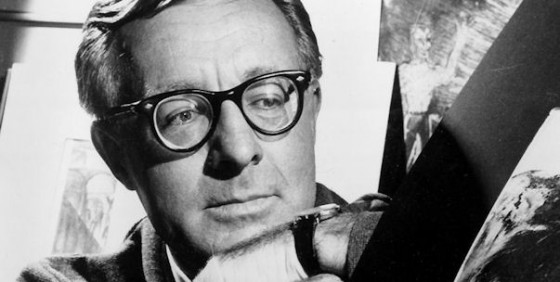
 Writer Ray Bradbury, who died this week at age 91, told tales in such a unique voice and with such simple grace. As I was reading about his life and works this week, I learned that a digital copy of his book, "The Martian Chronicles". was sent to Mars in 2007 aboard the Phoenix spacecraft which landed near the Martian North Pole. And in August of this year, a robotic mission to Mars by a craft named Curiosity will land and many have already suggested the landing site should be called the Ray Bradbury Memorial Station.
His awards and achievements are many. President Obama expressed what many of us thought this week about Ray Bradbury:
"For many Americans, the news of Ray Bradbury's death immediately brought
to mind images from his work, imprinted in our minds, often from a
young age. His gift for storytelling reshaped our culture and expanded
our world. But Ray also understood that our imaginations could be used
as a tool for better understanding, a vehicle for change, and an
expression of our most cherished values. There is no doubt that Ray will
continue to inspire many more generations with his writing, and our
thoughts and prayers are with his family and friends."
Back in 2005 when I first began writing this blog, I wrote about my own thoughts about Mars as images of dust devils were filmed by a robotic platform sitting on the planet. I've always liked that post, and in many ways it was my attempt to create something Ray Bradbury would like to read. So, what follows below is a reprint of that post -- and thank you Ray for making our world and our endless sea of stars feel like home.
----
Aug. 23, 2005
MARTIAN
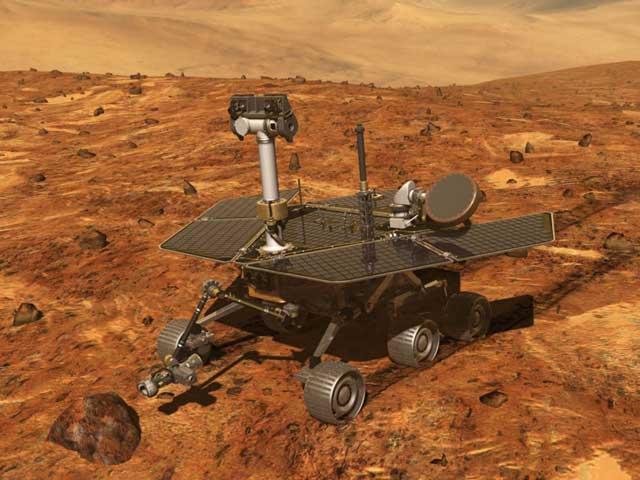
There are no people to see in the short movie, no mulit-limbed invasion squads. The camera filmed in some 12 minutes this passing of "dust devils" across the rocky expanse of Mars which I have sat and watched for maybe a half an hour. It is odd, really, here at this far technological beginning point, this moment and place where I can see what a camera on a remote control cart sees. How long, I wonder, will we Earth-folk take to build and then send other robots to Mars or beyond? In a hundred years, will some other inhabitant of this valley in eastern Tennessee watch robots taking clunky steps to build some empty metal shells that might house fuel or food or other robots? Will it take fifty years or maybe two hundred and fifty?
There have been recent discussions here on this planet about Science and Space and what Science is or should be. Some theories put forth that millions of years ticked past here on this world -- hundreds of millions -- and lifeforms bubbled and swam and clumped together, thanks to the water and the dirt and the air and the fire, and caught hold and started growing. Some theories put forth that a Creator, a Prime Force, made all there is on this planet in six days and rested on the seventh day from that labor. And not only what is on this planet, but everything out in this solar system and beyond it, millions and millions of other galaxies made of planets with fire and ice and gas and shattered meteor bits, and all in six days. It has taken a very very short span of some forty years, 1965 to 2005, for the inhabitants here to begin accept the ideas that inhabitants of other colors or gender might all have the same basic freedoms, another beginning point that is still revolutionary in terms of how we live with each other.
And here I sit, staring at the 17 second movie of dusty twists of wind, ragged white whips that lash back and forth across a desolate world.
Some even more primitive robots have, in less than 30 years, been shot out into the inky blackness which surrounds us, and other planets are photographed -- planets that are thick with heat and pressure, enormous swirling clouds of gas and storms that bring acids and liquid metals in a hazy sheet across a surface whose contents I can barely imagine or conceive. The robot cameras explode or dissolve into nothingness long before they can attain anything even remotely considered a "landing"..
I ponder the Martian landscapes and wonder about it's design -- why create such a place? What purpose does it hold? Were the robotic twins on the scene too soon or too late to catch a sight of intelligent, conscious creatures?
Why make a world of dust? Of ice?
Perhaps those winds are scattering particles of sand as part of a ten billion year planet renovation plan, and if so I doubt anything left in this valley on my home planet will know about it, even if I wish or hope that someone will be here to see a transformed world.
The Martian world today has little robots staring intently at rocks and dust devils, and people here, too, see it -- observing the location. I seem to understand so little of stars and atoms, I don't understand why the inhabitants here are so contentious and vile, or loving and compassionate in the face of such an enormous collection of galaxies filled with random winds and rotations. I am surprised we have not all stayed hidden in caves, full of fear from moment to moment, like we see it in the beginning of Stanley Kubrick's movie of space travel, "2001: A Space Odyssey".
But what always excited me watching that movie was that slow, rhythmic rolling dance of men and machines and planets all moving to the Blue Danube Waltz, and how thrilled I was just to see it, to observe this quiet emptiness of space and stars and galaxies whose movements I cannot comprehend. And at the end of "2001" (a title whose name once resonated with an implausible future and now is just part of our past), at the end of the movie the astronaut has been moved from the caves to the stars and Kubrick leaves me to make up my own mind about what I have seen, what it all might mean.
My niece told me some years ago she fell asleep when she watched the movie it was so boring to her. I could hardly believe it. How could anyone watch those images and not feel some kind of un-nameable connection. some sense of endless wonder, some urge to search among the stars?
Filming geologic time will not bring box office dollars.
Mars has been in our books and our imaginations for thousands of years. Once on a Halloween night it escaped from the radio and terrified thousands of radio listeners, and Mars landed on top of actor Tom Cruise this summer. TV gave us "My Favorite Martian", and in ancient days it was the home of Gods and myths barely remembered, and today I sit and watch the dust devils filmed on location, on Mars, with no laugh tracks, no panic in the streets.
Maybe the best way to think of it is as development property -- a slow development, true. But I can almost see it all as part of the view of Our backyard. I have to use my imagination, to consider time and distance and what Life requires or how Life must adapt. I have to be willing to consider so many theories, and if I dismiss the possibilities, then I limit my view and I might as well stay in the caves.
Saturday, March 28, 2009
Space Smells Funny, Astronauts Say
Is that funny ha-ha or funny strange?
Of course, NASA warns 'please do not open your helmet to get a big whuff.'
Wonder if there are funny smells inside the space station?
Of course, NASA warns 'please do not open your helmet to get a big whuff.'
Wonder if there are funny smells inside the space station?
Saturday, September 27, 2008
NASA Turns 50, US Has To Hitch A Ride Into Space

This week marked the 50th anniversary of the NASA agency just as the Chinese made their first successful spacewalk and as the U.S. Senate was forced to approve a plan allowing U.S. astronauts to buy seats on Russian spacecraft so we can reach the International Space Station, just as the ISS nears completion.
The achievements of our efforts in science and space exploration are too often viewed with nostalgia for the past rather than vision for the future. NASA - and science in general - has been pushed to the sidelines by recent leadership in Washington, a move which will only serves to hamper the nation's role in cutting edge development across a wide range of scientific research and development and education as well.
Aviation Week had a fine piece attempting to connect the past with the present and future challenges of space science:
"The ISS is arguably an engineering triumph for NASA comparable to the Moon landings, in difficulty if not historic impact. Humans have been living on the station continuously for eight years now, operating through an intricately choreographed construction project that has merged hardware from three continents into a functioning outpost more than 200 mi. above Earth's surface.
"But space exploration is still in its infancy, and there is a new generation of engineers and managers coming along at the field centers who have the intelligence, skills and confidence that powered their fathers and grandfathers from Explorer to Apollo to the Hubble, space shuttle and ISS.
Today they are planning an international outpost on the rim of the Moon's Shackleton Crater and a new flagship robotic mission to one of the outer planets. On the aeronautics side of the house, "the first 'A' in NASA," plans and technology are being developed for the next generation of the U.S. air transportation system.
In an election year, the ball isn't in the agency's court. NASA's next half-century - indeed its next year - will be determined by the voters, and the leaders they elect. It's probably a good time to remember John F. Kennedy's statement on picking national challenges "not because they are easy, but because they are hard."
I'd expect we can lump this program into all the others the Bush administration has left in a tangled mess, like the current financial meltdown: balance the cost of doing nothing against the costs of the failure of everything.
It's the Bush approach to bumble between failure and over-reaction to problems which have been allowed to fester and grow. When typical agency response botches the job of just getting ice and water to the ravaged Gulf Coast after Katrina, NASA has over the last eight years done remarkably well. Billions have been lost to fraud and waste in military contracts abroad and to domestic programs feebly attempting reconstruction along the Gulf.
What awaits the next president and the next Congress is a sprawling nest of critical mistakes so large and complex it will affect each citizen of this nation and those of countless others.
A recent AIAA Space Conference in San Diego offers some much needed perspective on how the politics of today and the future are linked:
"Space has proven to be the silent backbone underpinning our commercial, civil, and military sectors. Three of the top issues in the upcoming election—economic competitiveness, the global war on terror, and the need for increased global climate change monitoring—are all dependent on our technological and operational achievements in space."
Wednesday, August 06, 2008
Sending Your DNA Into Orbit
It's being called "Operation Immortality", an attempt to launch a saving throw for humanity into outer space.
The truth is much simpler. Richard Gariott, the video game tycoon, is the next "tourist" taking a flight to the International Space Station and he's running a contest to promote his new video game, "Tabula Rasa" in which U.S. residents can get a digital DNA sample and/or game character placed on a memory stick (aka The Immortality Drive) which he will ferry to the ISS.
The ISS really just needs to start selling advertising space on the exterior of the orbiting platform.
The recent commercial efforts for space earned one failure this past weekend when the latest SpaceX launch apparently exploded and thus lost the ashen remains of poor James "Scotty" Doohan and astronaut Gordon Cooper aboard the craft.
Richard Branson meanwhile is working on a mere $200,000-per-ticket fare for short orbital flights.
Until the price decreases, I'll have to settle for sending a digital-code version of this blog out into the universe via this site.
The truth is much simpler. Richard Gariott, the video game tycoon, is the next "tourist" taking a flight to the International Space Station and he's running a contest to promote his new video game, "Tabula Rasa" in which U.S. residents can get a digital DNA sample and/or game character placed on a memory stick (aka The Immortality Drive) which he will ferry to the ISS.
The ISS really just needs to start selling advertising space on the exterior of the orbiting platform.
The recent commercial efforts for space earned one failure this past weekend when the latest SpaceX launch apparently exploded and thus lost the ashen remains of poor James "Scotty" Doohan and astronaut Gordon Cooper aboard the craft.
Richard Branson meanwhile is working on a mere $200,000-per-ticket fare for short orbital flights.
Until the price decreases, I'll have to settle for sending a digital-code version of this blog out into the universe via this site.
Monday, July 21, 2008
Hey Up There - Good Job

It's just a year shy of the 40th anniversary, but as each July rolls past I still marvel at what some bold and brave and ingenious folks did back in the summer of 1969.
Their actions were not swaddled in safety, they took risks beyond imagining.
I recall most vividly watching the blurry black and white images flickering on television, feeling the tension of all who were with me (my family and some friends), tension which engulfed us one and all.
After I had watched their amazing and tentative steps for some several minutes, I went outside and looked up into the sky. It was a very humid night and I recall wondering how many other people all across our own planet were also looking up as well.. I did not know then, as I do know, that the two men landing on the Moon for the first time touched down on the surface with bare seconds of fuel left, or that Commander Neil Armstrong had taken manual control of his craft and steered his frail ship with steel-strong courage to complete his mission.
I stared upwards for a long time and then, being just a wee child, I decided to wave up at the sky and say "Hey up there. Good job." And I was pretty sure that even if they could not hear me, I liked thinking that much of the world was doing the same thing. The footprints I made that night in the thick grass of the backyard disappeared moments after I made them. The footprints they made did not.
I continue to admire Armstrong and Buzz Aldrin and the handful of other explorers who also made the journey there and back again. And for some odd reason, I am proud that one of those first two explorers was named "Buzz". It was as if it somehow brought outer space closer to home, and took home out into space.
So cheers to these men, and to all those who helped achieve that moment in history. Thanks for your courage.
UPDATE: I was reminded by this recent post from the one and only Squirrel Queen that you can add your name to a giant list of names which NASA is sending to the moon. No, really. Add your name by July 25 at this link. I added mine gladly.
SQ writes on her post on this topic: "NASA is now allowing folks to submit their John Hancock to a database which will be placed on a microchip and put on the Lunar Reconnaissance Orbiter, or LRO, spacecraft. The LRO will be in orbit around the big green cheese in the sky for many years."
So now I am a bit closer the surface than I have ever been. And what a fine way to observe the anniversary for the first lunar landing by humans.
Sunday, April 13, 2008
New Monument for Space Dog Laika

Officials unveiled a monument Friday to Laika, the first dog (and first earthling) to travel into space. The announcement was timed to coincide with the April 12th anniversary of the flight of the first human into space, Yuri Gagarin, whose short journey took place in 1961.
Scientists collected a number of stray dogs for the test-flight in 1957 hoping to learn if a living creature could stand a roaring blast into orbit. Many details of the flight of Laika remained secret for decades, but the wee pup had to wait until this century for the entire story to be told. Due to some technical problems, she had to wait inside her small capsule for three days on the launch pad before blast off. While early reports said she lived for four or five days of orbit, we know now she died within a few hours when the cabin overheated. The capsule itself continued to orbit for 162 days before falling in a ball of fire through the atmosphere.
It's doubtful much was learned to benefit research from her trip into space. Over the years, her fame and her story have and continue to be memorialized. It's as if we all feel a little guilty about hurling the pup on a suicide mission.
Now while I would prefer having the companionship of a friendly lady astronaut were I to be selected for some space travel, a dog would be my second choice. (Some might choose a monkey, and the wee space monkey named Able is a mummified museum display these days.)
One of the dogs successfully sent into orbit and returned safely was named Strelka, and after her return she had a liter of pups, one of which was sent to President Kennedy as a gift for his kids.
I just like the fact that in a thousand years, the statue of Laika may still be here on Earth, a stray who found a home in the history of the world.
Sunday, July 01, 2007
The POOF (Privately Owned Orbital Facility) Is Out There
Bigelow Areospace, based in Nevada, has been quietly working on new ways to haul components into orbit and create a space station. The tech centers on using inflatable and flexible modules and manned projects are planned for the near future
Genesis 2 launched on June 28th, and is the process of expanding it's dimensions and establishing camera connections.
Details of the current project and future plans are all available here.
Genesis 2 launched on June 28th, and is the process of expanding it's dimensions and establishing camera connections.
Details of the current project and future plans are all available here.
Monday, May 07, 2007
Da Vinci Goes to the Air and Space Museum
The blend of work and pleasure has happened to me more than once, but the past week was one of the most memorable such blends. I hope it is also a sign that the future holds even more opportunities where work and pleasure co-exist for your humble narrator.
I'll explain some of the details of the how and the why in a later post. For now, let me just offer some tantalizing examples of why I had a fine week.
Imagine getting an offer to fly to Washington DC and stay at the ritzy Washington Court Hotel, all expenses paid, and to spend my working hours entertaining folks as a historical character -- in my case I performed as a Russian Cosmonaut and as Leonardo da Vinci. Added bonus - I was told I would be performing the da Vinci role at the Smithsonian's Air and Space Museum, which would be closed for the evening for a private catered party.
I had to pinch myself more than once at Air and Space. It's a place which I had visited before, spending hours wandering thru the exhibits and gawking at the displays of planes and rockets which made history. To be strolling casually through it, sipping wine and acting as da Vinci ("I invented everything here, you know. I never finish, I just make a sketch.") while a jazz combo played just under the heat shield of the Apollo 11 Command Module ... and to be paid while doing all that ... it makes you say Life is Good.
It also made me think if I ever do go to space, I want a jazz combo on board playing the whole time. Jazz and Space. Each compliments the other.
 As I mentioned in my previous post , my camera wasn't working, but fellow performer MountainGirlXD was kind enough to share the photos she took. So here you are -- first, me as daVinci. The costume wasn't too uncomfortable, but man that hair and beard took some work so it did not look like Santa. A little bit of make-up was needed too, so that the wig did not look Mamie Van Doren's hair and too much would have made me look like Bob in Twin Peaks. One thing I learned was that about half of those I talked with thought that da Vinci painted the Sistine Chapel. And just for the record, I doubt there would much difference between da Vinci's astonishment inside that museum and mine.
Sadly, as exciting as the exhibits were, I hate to think we now see space exploration as merely an exhibit in a museum, part of our past. It must remain part of our future, too.
Here's a shot of the X-1, which broke air speed records when piloted by Chuck Yeager.

I admit to being stunned when thinking that a company could rent out the museum for the evening and have dinner catered. I'm sure I could live quite well for years on what that must have cost.

In the next post, I'll have more on how I landed the job last week and other tales from Washington, so stay tuned.
Oh, and why not take a peek at MountainGirlXD as she played the role of Amelia Earhart?

I'll explain some of the details of the how and the why in a later post. For now, let me just offer some tantalizing examples of why I had a fine week.
Imagine getting an offer to fly to Washington DC and stay at the ritzy Washington Court Hotel, all expenses paid, and to spend my working hours entertaining folks as a historical character -- in my case I performed as a Russian Cosmonaut and as Leonardo da Vinci. Added bonus - I was told I would be performing the da Vinci role at the Smithsonian's Air and Space Museum, which would be closed for the evening for a private catered party.
I had to pinch myself more than once at Air and Space. It's a place which I had visited before, spending hours wandering thru the exhibits and gawking at the displays of planes and rockets which made history. To be strolling casually through it, sipping wine and acting as da Vinci ("I invented everything here, you know. I never finish, I just make a sketch.") while a jazz combo played just under the heat shield of the Apollo 11 Command Module ... and to be paid while doing all that ... it makes you say Life is Good.
It also made me think if I ever do go to space, I want a jazz combo on board playing the whole time. Jazz and Space. Each compliments the other.
 As I mentioned in my previous post , my camera wasn't working, but fellow performer MountainGirlXD was kind enough to share the photos she took. So here you are -- first, me as daVinci. The costume wasn't too uncomfortable, but man that hair and beard took some work so it did not look like Santa. A little bit of make-up was needed too, so that the wig did not look Mamie Van Doren's hair and too much would have made me look like Bob in Twin Peaks. One thing I learned was that about half of those I talked with thought that da Vinci painted the Sistine Chapel. And just for the record, I doubt there would much difference between da Vinci's astonishment inside that museum and mine.
Sadly, as exciting as the exhibits were, I hate to think we now see space exploration as merely an exhibit in a museum, part of our past. It must remain part of our future, too.
Here's a shot of the X-1, which broke air speed records when piloted by Chuck Yeager.

I admit to being stunned when thinking that a company could rent out the museum for the evening and have dinner catered. I'm sure I could live quite well for years on what that must have cost.

In the next post, I'll have more on how I landed the job last week and other tales from Washington, so stay tuned.
Oh, and why not take a peek at MountainGirlXD as she played the role of Amelia Earhart?

Subscribe to:
Posts (Atom)