Friday, October 10, 2014
'Gone Girl' - David Fincher's Social Critique
"As a director, film is about how you dole out the information so that the audience stays with you when they're supposed to stay with you, behind you when they're supposed to stay behind you, and ahead of you when they're supposed to stay ahead of you." -- David Fincher
It's so good to see a storyteller like David Fincher achieve popular success without chucking away the thought and artistry that make movies more than just memorable - his films almost haunt you and refuse to dissipate. His newest movie, "Gone Girl", is imminently a marketing dream (best-selling novel, hot topic actors), but troubling, provocative under-currents stream all through the show.
His other films, "The Social Network", "Se7en", "Zodiac", "Fight Club", "Girl With The Dragon Tattoo" and his TV series "House of Cards" - are careful, meticulous compositions that blend the images, words and sounds into something far more than the sum of their parts. It's a hell of a critique on modern times.
There's a panic-filled America on display. Institutions (business, marriage, class structure, school, judicial systems, finance, journalism, politics) are craggy, crumbling and crippled and still must be negotiated, traveled and endured. The only thing more dislocative than being inside these edifices is to be without them. Fincher nails this eroding world expertly:
"Gone Girl explodes marriage,” says Rebecca Traister. “And it explodes precisely the one kind of marriage that is still idealized, between white, urban sophisticated people that meet in mid-life. There are many marriage models out there but this is the one that is still viewed aspirationally: between white, beautiful, privilege educated New Yorkers. That is the picture of marriage that is sold to us, the one we all must desire. And that is the one the book vandalises. So there is a subversive argument being advanced about marriage in the film, that it's not an institution that can tame women any longer."
From Gillian Flynn's novel, "Gone Girl":
"It seemed to me that there was nothing new to be discovered ever again. Our society was utterly, ruinously derivative (although the word derivative as criticism is itself derivative). We were the first human beings who would never see anything for the first time. We stare at the wonders of the world, dull-eyed, underwhelmed. Mona Lisa, the Pyramids, the Empire State Building. Jungle animals on attack, ancient icebergs collapsing, volcanoes erupting. I can't recall a single amazing thing I have seen firsthand that I didn't immediately reference to a movie or TV show. . . . You know the awful singsong of the blase: Seeeen it. I've literally seen it all, and the worst thing, the thing that makes me want to blow my brains out, is: the secondhand experience is always better. The image is crisper, the view is keener, the camera angle and the soundtrack manipulate my emotions in a way reality can't anymore. I don't know that we are actually human at this point, those of us who are like most of us, who grew up with TV and movies and now the Internet. If we are betrayed, we know the words to say; when a loved one dies, we know the words to say. If we want to play the stud or the smart-ass or the fool, we know the words to say. We are all working from the same dog-eared script."
And there's still enormous amounts of wit and satire, a sense of the playful amid the horror show of the current age. "Gone Girl" likewise challenges perceptions - and makes box office bucks too.
His approach to "Gone Girl". Another recent interview here.
"Anybody looking outside themselves to make themselves whole is delusional and probably sick." - David Fincher
Thursday, March 03, 2011
Philip K. Dick's Dystopian World Taking Over?
"Because today we live in a society in which spurious realities are manufactured by the media, by governments, by big corporations, by religious groups, political groups...So I ask, in my writing, What is real? Because unceasingly we are bombarded with pseudo-realities manufactured by very sophisticated people using very sophisticated electronic mechanisms. I do not distrust their motives; I distrust their power. They have a lot of it. And it is an astonishing power: that of creating whole universes, universes of the mind."
It should not be surprising - but it is - that we seem to be truly inhabiting the dystopian world envisioned by science fiction writer Philip K. Dick. His works explored perception, reality, paranoia, corporate worship, identity, computer technologies, constant surveillance, the mass marketing of tragedy, an emerging global polyglot society and so much more which seems to resonate so strongly with generation after generation. And today his ideas serve as a rich and fertile field for cultural exploration.
Reports are flying today of the rights being secured to create sequels and prequels a TV series and maybe a remake of the movie "Blade Runner" - which already exists as a 5-disc movie collection on DVD with all variant versions and documentaries. Producers seem to be aiming at creating movies within the world created in Ridley Scott's movie -- and already there are 3 novels based in the BR world from writer K.W. Jeter. And the Total Recall 2010 TV series also blended that movie and Total Recall (based on another PKD story) into a short-lived and rather awful TV show.
Really what they are aiming at is franchising writer Philip K Dick, whose works constitute nearly an industry unto themselves - witness this weekend's arrival of "The Adjustment Bureau" based on PKD's short story. an independent film of his novel "Radio Free Albemuth" is seeking a distributor, Disney has an animated feature in production based on "The King of the Elves", and apparently two films called "The Owl In Daylight", one a documentary, are being created as well. A look at 9 of the movies made based on his work so far is here.
Largely regarded as one of his best works, the alternate history of the world wherein the Allies lost World War 2, "The Man In The High Castle", is in production as a mini-series on BBC, spearheaded by Ridley Scott.
The number of new books, festivals, new films, music, and new collections of his work is so large it's more than impossible to list.
I've always enjoyed reading his work (and some of the movies) but I was always left with the great hope that little of his perceived futures would come to pass. He wrote of society endlessly deceived and deluded and controlled by great wealth and nefarious leaders, a hopeless and helpless humanity, yet one in which he searched for hope.
Some years back, a project was launched to create a functioning android with artificial intelligence was created using a model of Dick's face and speech patterns. It was beyond spooky and got stranger still when the head of this android was accidentally lost and went traveling via airplane to California.
The creators were adamant however and now are presenting their creation again, though work is still to be completed for creating an artificial intelligence for the android. A video sample of the PKD2 is quite surreal.
"Dick's fiction calls up our basic cultural assumptions, requires us to reexamine them, and points out the destructive destinations to which they are carrying us. The American Dream may have succeeded as a means of survival in the wilderness of early America; it allowed us to subdue that wilderness and build our holy cities of materialism. But now, the images in Dick's fiction declare, we live in a new kind of wilderness, a wasteland wilderness, because those cities and the culture that built them are in decay. We need a new American dream to overcome this wasteland."
- Patricia S. Warrick, Mind in Motion: The Fiction of Philip K. Dick (1987)
Wednesday, January 05, 2011
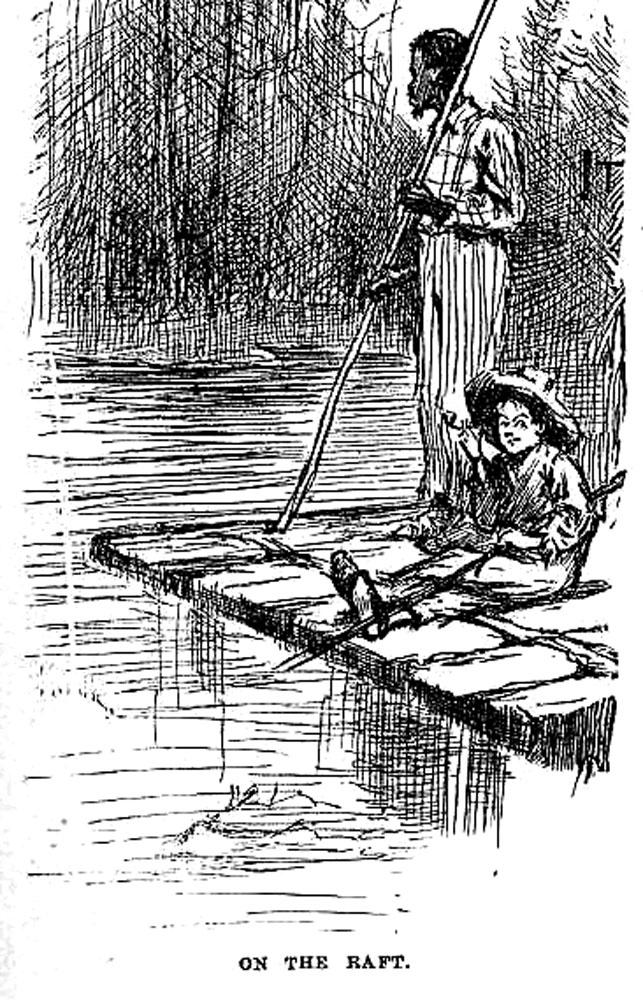
Publisher's Shameful Censorship of 'Huckleberry Finn'
An Alabama-based publisher is making news as their new edition of Mark Twain's "Adventures of Huckleberry Finn" and The Adventures of Tom Sawyer" will be censored to remove what they call "hurtful epithets" and to halt "preemptive censorship" of Twain's novel. But the motive is most likely to A.) get publicity and B) sell books.
So no use of the word "injun" and the word "slave" will replace the word most often referred to today as the "n-word". It's a cheap shot at fame or infamy from the publisher, NewSouth Books, which offers a defense here and even has a blog on their actions here.
"We may applaud Twain’s ability as a prominent American literary realist to record the speech of a particular region during a specific historical era, but abusive racial insults that bear distinct connotations of permanent inferiority nonetheless repulse modern-day readers. Twain’s two books do not deserve ever to join that list of literary “classics” he once humorously defined as those “which people praise and don’t read,” yet the long-lofty status of Tom Sawyer and Huckleberry Finn has come under question in recent decades. In this connection, it seems relevant to remember that Twain habitually read aloud his day’s writings to an audience gathered on the porch of his summer retreat overlooking Elmira, New York, watching and listening for reactions to each manuscript page. He likewise took cues about adjusting his tone from lecture platform appearances, which provided him with direct responses to his diction. As a notoriously commercial writer who watched for every opportunity to enlarge the mass market for his works, he presumably would have been quick to adapt his language if he could have foreseen how today’s audiences recoil at racial slurs in a culturally altered country."
Wrong.
The assumption is that the novels are fundamentally flawed. And it's likewise sad to see educated people and publishers embrace censorship rather than scholarship. By dropping the language the publishers remove and reconstruct the history and the themes of the book, which focused a laser-sharp attention on prejudice and the destruction that prejudice leveled at our nation.
Claims that the changes will halt the books from being banned, to allow for more school-age youngsters to read the books are deceitful. Any Twain scholar worth a dime can offer up Twain's own response to censorship of his work and his response to allowing children to read his works:
"I am greatly troubled by what you say. I wrote 'Tom Sawyer' & 'Huck Finn' for adults exclusively, & it always distressed me when I find that boys and girls have been allowed access to them. The mind that becomes soiled in youth can never again be washed clean. I know this by my own experience, & to this day I cherish an unappeased bitterness against the unfaithful guardians of my young life, who not only permitted but compelled me to read an unexpurgated Bible through before I was 15 years old. None can do that and ever draw a clean sweet breath again on this side of the grave."
Such a deft handling of idiotic worries of so-called community standards.
Another defense of the censorship - strike that - another defense of changing the entire meaning of the novel claims:
"New South is simply giving educators and other readers the option of enjoying Twain's work without tripping over a derogatory term, especially one coming from its hero."
Wrong. The derogatory worldview Twain presents is precisely what he wanted readers to confront. If you remove the challenging language, what's left? A light-hearted romp across the countryside? If the characters don't address the reality that many in America at that time viewed Jim as sub-human just because of his skin color, then the book's meaning is gutted. If a teacher wants students to read Twain's work absent it's meaning and context, then what is it exactly they are teaching?
And one more note for these alleged "scholars" about what kids today read or are capable of comprehending - the top bestselling Young Adult book last year? The Hunger Games: a futuristic tale where the government selects a boy and a girl from various districts to fight to the death on live TV.
Monday, September 20, 2010
19th Century Pulp Fiction
Emory has placed 1,200 of these novels as PDF files online:
"Yellowbacks were cheap, 19th century British literature sold at railway book stalls, with colorful, sensational covers to attract buyers. While some were well-known books such as “Sense and Sensibility,” many of the yellowbacks were obscure titles by authors unknown nowadays. “They were the equivalent of a popular novel you’d read on a plane today,” says David Faulds, MARBL’s rare book librarian.
"The genres and topics include romance, detective fiction, war, biography, medicine, horse racing, hunting and fishing. “Some of these books are so rare that they’ve been lost to history,” Faulds says. “Scholars and casual readers can now discover these works. There may be aspects of them that are of interest not only to literary researchers but also social historians looking at Britain or America in the 19th century or women’s lives in this period – what they were reading, how they are portrayed or what they wrote.”
You’ll need Adobe Acrobat Reader. To access the yellowbacks:
1. Click here http://bit.ly/bPUGd4 for a preloaded search of "Emory digital library" yellowbacks, or search for a yellowback title or author of your choice.
2. Click on the selection you wish to read, or click on the green "online access" link next to the entry. (Or scroll down under details, and at the second blue arrow, right-click on "PDF version," then click on "open in new window.")
3. The yellowback will load; note the first page is usually blank. You can then save the novel to your desktop or a flash drive and read it at your leisure."
Tuesday, October 09, 2007
"Nobodies": John Bowe on Modern Slavery

Slave labor is sadly alive and well - and not in some distant third world nation. It thrives in the U.S., puts food and clothing in local stores and restaurants, all documented in journalist John Bowe's new book "Nobodies: Modern American Slave Labor and the Dark Side of the New Global Economy" from Random House.
The facts are grim and depressing, and Bowe's book of investigative reporting is nearly impossible to put down once you begin reading. Bowe starts with events in Florida, where companies rely on modern indentured servants to provide products for major companies like PepsiCo, Taco Bell, Tropicana and many more. Herded into hellish camps and manipulated with brutality by labor contractors, one known as El Diablo, human life is worth little. Providing products for sale trumps all other concerns.
In Tulsa, Oklahoma, the John Pickle Company, which makes pressure tanks for oil companies and power plants, workers from India arrived only to have their documents confiscated, forced to live inside a factory building and work for three dollars an hour.
In Saipan, the U.S. Commonwealth, workers make clothing for national retail chains like The Gap and Target - yet free from all U.S. labor standards and immigration controls. Labels are allowed to read MADE IN THE USA, thanks to congressional efforts from Tom DeLay. Most of the workers are women, who earn three dollars an hour and are urged to trade sex for green cards.
Bowe's book is scathing, telling true stories of how much the U.S. economy has melded with brutal labor camps, exempt from law enforcement standards and operate with the local and national officials all ignoring the sometimes deadly camps.
You can read an excerpt from Bowe's book here. Bowe is interviewed by Doug Krizner here.
For most readers, "Nobodies" will astonish and terrify. It not only tells the stories of those forced to work in constant fear and poverty, but also reveals how items we consume daily come from such labor.
Wednesday, August 08, 2007
Internets Destroying The World, or Idiocracy Revisited
That is the core of a book, titled "The Cult of the Amateur: How the Democratization of the Digital World Is Assaulting Our Economy, Our Culture and Our Values" by one Andrew Keen.
Damn that urge for Democracy!!
A review of the book via Sports Media America says:
"... the proliferation of Web technology and its wide and easy access to any Joe or Jane has created a rudderless, authority-less media environment responsible for the following primary ills:
1. A general and alarmingly casual disregard for facts (i.e., the truth about certain things)
2. A democratized approach to learning (e.g., Wikipedia), wherein those with expert opinion (and conventional credentials) are being pushed aside by an army of amateur thinkers and journalists
3. The rapid (and continuing and probably inevitable) financial decline in traditional media such as newspapers and magazines
4. The absolute destruction of the music business as we once knew it
5. The potential destruction of the film business
6. A compromised society-wide morality (especially among the younger, cut-and-paste generations) that fails to recognize theft of intellectual property as a criminal act (Keen dubs this scene a kleptocracy)
7. An onslaught of exposure to pornography that is warping minds and further fueling an atmosphere where sexual deviance and predatory activities are fostered."
(Thanks to Sparkwood & 21 for this account of the book.)
And don't forget the Evils of learning to read, of speaking without being a hired representative, and thinking for yourself. Add in the devious unprofessional handling of music, politics and documentation .... well, here we are, in a digital handbasket in a large pipeline heading to Hell.
Sunday, July 15, 2007
Outsourcing the CIA
Over the past five years (some say almost a decade), there has been a revolution in the intelligence community toward wide-scale outsourcing. Private companies now perform key intelligence-agency functions, to the tune, I'm told, of more than $42 billion a year. Intelligence professionals tell me that more than 50 percent of the National Clandestine Service (NCS) -- the heart, brains and soul of the CIA -- has been outsourced to private firms such as Abraxas, Booz Allen Hamilton, Lockheed Martin and Raytheon." (Via the Washington Post)
The above story was penned by writer R.J. Hillhouse, who also writes her own blog, The Spy Who Billed Me. She also happens to have a new novel out, titled "Outsourcing", a fictional thriller about the privatization of the intelligence community, and whose sales will likely benefit from her article in the Washington Post.
Her site includes this description of herself:
"Dr. Hillhouse has run Cuban rum between East and West Berlin, smuggled jewels from the Soviet Union and slipped through some of the world’s tightest borders. From Uzbekistan to Romania, she's been followed, held at gunpoint and interrogated. Foreign governments and others have pitched her for recruitment as a spy. (They failed.)
A former professor and Fulbright fellow, Dr. Hillhouse earned her Ph.D. in political science at the University of Michigan.
Wednesday, April 11, 2007
And The Band Plays On ...
"We’ve got a gang of clueless bozos steering our ship of state right over a cliff, we’ve got corporate gangsters stealing us blind, and we can’t even clean up after a hurricane much less build a hybrid car. But instead of getting mad, everyone sits around and nods their heads when the politicians say, “Stay the course.”
Stay the course? You’ve got to be kidding. This is America, not the damned Titanic. I’ll give you a sound bite: Throw the bums out!
You might think I’m getting senile, that I’ve gone off my rocker, and maybe I have. But someone has to speak up. I hardly recognize this country anymore."That's an excerpt from an upcoming book by Lee Iacocca, "Where Have All The Leaders Gone?"
The full excerpt is here.
Today's news that the White House, attempting to reorganize (again) the running of the wars in Iraq and Afghanistan, is having trouble finding a military official willing to take such a job is another troubling indication that the policies are floundering.
"The very fundamental issue is, they don't know where the hell they're going," said retired Marine Gen. John J. "Jack" Sheehan, a former top NATO commander who was among those rejecting the job."