
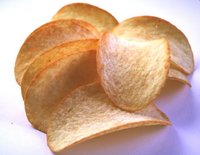
The Supreme Court of Judicature in Britain has ruled on the legal question of "Is a Pringle a potato chip?
"With citations ranging from Baroness Hale of Richmond to Oliver Wendell Holmes, Lord Justice Robin Jacob concluded that, legally, it is a potato chip.
The decision is bad news for Procter & Gamble U.K., which now owes $160 million in taxes. It is good news for Her Majesty’s Revenue and Customs — and for fans of no-nonsense legal opinions. It is also a reminder, as conservatives begin attacking Judge Sonia Sotomayor for not being a “strict constructionist,” of the pointlessness of labels like that.
In Britain, most foods are exempt from the value-added tax, but potato chips — known as crisps — and “similar products made from the potato, or from potato flour,” are taxable. Procter & Gamble, in what could be considered a plea for strict construction, argued that Pringles — which are about 40 percent potato flour, but also contain corn, rice and wheat — should not be considered potato chips or “similar products.” Rather, they are “savory snacks.”---
"The Supreme Court of Judicature had little patience with Procter & Gamble’s lawyerly attempts to break out of the potato chip category. The company argued that to be “made of potato” Pringles would have to be all potato, or nearly so. If so, Lord Justice Jacob noted, “a marmalade made using both oranges and grapefruit would be made of neither — a nonsense conclusion.” He was even more dismissive of Procter & Gamble’s argument that to be taxable a product must contain enough potato to have the quality of “potatoness.” This “Aristotelian question” of whether a product has the “essence of potato,” he insisted, simply cannot be answered."
This is what courts are for, I suppose.
But no Pringle I have ever munched upon ever reached the level of potato chip, according to my taste buds.
SEE ALSO: The patent on Pringles.


