6. Invest in energy research and development. A cost-competitive 500-mile battery would virtually guarantee electrification of half our cars and trucks. Reduce the cost of solar power by a factor of four. Find a way for utilities to make money from the CO2 their coal plants produce.
Saturday, June 28, 2014
The Empty Slogan Act for 2014 Re-Election Campaigns
Thursday, March 15, 2012
Pennsylvania - America's First Corporate State?
Tuesday, December 20, 2011
I Could Have Been A Potash Tycoon
And these thoughts were instigated by one thing - potash.
I recall learning about potash when I was a young schoolboy - it was an ancient creation, made by burning plants and trees and mixing the resulting ashes into a field where one wanted to grow food. The ashes were loaded with potassium, but we have since found that there are massive sources of potassium already in existence underground, so it is mined and sold worldwide for everything from fertilizer to plastics to textiles and much, much more.
(A side note here - my high school chemistry teacher really did not open up much of an exploration of chemistry as such. She was in the midst of a divorce and was realizing she was a lesbian and was concerned with the daily issues of running a small donut shop with her husband when she taught my class. On the plus side: we had hot fresh donuts every day, usually kept warm in a rather expensive incubator in the chemistry classroom. But I digress.)
As I said, the word potash came up when I read a report yesterday about a 22-year-old Russian lady who just paid the most ever recorded for an apartment - $88 million for a ten-room flat in Manhattan, about $13,000-plus per square foot. She is Ekaterina Rybolovleva, the heir of Potash Tycoon Dmitry Rybolovleva, who last year sold his share of the Russian potash company Uralkali for $6.5 billion. (His Wikipedia page is an oddly translated tale of fabulous wealth and personal strife, including a murder charge for which he was ultimately acquitted. ) Ekatrina is apparently only going to use the apartment when she 'visits' Manhattan.
There are really only a few companies controlling the potassium market - the Potash Corp. of Canada, Uralkali and Belaruskali, and another North American company called Mosaic. But we're not done yet - "The global trade in potash is even more concentrated, with just two syndicates dominant: Canpotex managing sales of the three North American majors, Potash Corp, Mosaic and Agrium; and BPC, a joint venture combining Uralkali and Belaruskali."
According to the report cited above, the price is expected to surge in the next decade, from around $400 a ton to $1500 a ton. Of course, like most items traded on the global markets, the economic collapse in 2008 dropped the price, but it is on the rise again - potash is vital for bio-fuels and for growing more and more food for folks who live in India and China and Brazil and everywhere else. And it's a vital manufacturing component for just about everything.
Potash is Big Business.
And never once did anyone tell me, "Son, invest in potash". And what I thought I knew about potash and potassium turned out to be damned little. And I learned just a wee bit more about the faceless and nameless few who control patents on chemical elements and the global economy.
And like Billy Pilgrim, I sit here all old and stuff, my feet turning blue in the cold, pecking away at a keyboard and being a curmudgeon. "Potash," I mutter to no one. "Potash."
Wednesday, July 13, 2011
Light Bulbs and Economic Nightmares
A very strong indication of this took place during a vote Tuesday in Congress - a vote based on emotional madness which rejects facts and instead embraces myths.
As I mentioned yesterday, Tennessee Rep. Marsha Blackburn (and every Republican representative in the state signed on as co-sponsors) wailed that the evil liberal government was poised to outlaw the humble light bulb and eliminate all humble incandescent light bulbs. None of their claims were true. And in a push to get a vote to repeal energy efficiency, they needed a two-thirds majority to pass their bogus bill. The failed - only two TN reps., Cohen and Cooper voted no. Reps. Black, Blackburn, DesJarlais, Duncan, Fincher, Fleischmann, and Roe all voted to support the fake fears of light bulb bans.
Industry leaders all pointed out before the vote just how the plan to increase energy efficiency actually is driving innovation and job creation:
"Blackburn and others also note that most CFLs – Blackburn in her House floor speech Monday said “all” – are made in China, and that the last major General Electric plant making ordinary incandescent bulbs, in Winchester, Va., closed last September, taking 200 jobs.
Those bulbs, which the Natural Resources Defense Council, a Washington-based think tank, says waste 90 percent of the electricity they consume as heat, cannot meet the energy standards that go into effect in 2012.
But the NRDC notes that the 2007 increased efficiency standards have been embraced by the National Electrical Manufacturers Association, the trade association for domestic light manufacturers, as well as the leading manufacturers themselves.
The NRDC points out that the standards have “jump-started domestic industry investment in research and development and production of more efficient lighting products.”
It points to a factory in St. Marys, Pa., retooling to make more efficient incandescent bulbs, a new factory for CFLs opening in Ohio this year and “thousands of jobs” being created by companies such as Cree, Lighting Science Group and Phillips Lighting.
The NRDC also released a statement quoting Barry Edison Stone, the great-grandson of the inventor of the incandescent bulb, suggesting proponents of the repeal of the higher standards are “narrow-minded.”
And again, more facts get ignored:
"The law does not ban the use or manufacture of all incandescent bulbs, nor does it mandate the use of compact fluorescent ones. It simply requires that companies make some of their incandescent bulbs work a bit better, meeting a series of rolling deadlines between 2012 and 2014.
Furthermore, all sorts of exemptions are written into the law, which means that all sorts of bulbs are getting a free pass and can keep their energy-guzzling ways indefinitely, including “specialty bulbs” like the Edison bulbs favored by Mr. Henault, as well as three-way bulbs, silver-bottomed bulbs, chandelier bulbs, refrigerator bulbs, plant lights and many, many others."
Visit msnbc.com for breaking news, world news, and news about the economy
Wednesday, June 29, 2011
Tennessee Media FAIL - Bogus Claims in "Pork" Report
It is most likely that Tennesseans will read or hear a report today from their newspapers and TV stations which will claim hundreds of millions of tax dollars being wasted by Tennessee government, but is any of it true or are local news folks just pushing a press release without checking any of the claims it presents? (Hint: the answer is: yes.)
The self-proclaimed "non-partisan think tank", the Tennessee Center for Policy Research, tends to be mostly partisan, and is rather low on the thinking scale too. Still today they are pushing (and news outlets are reprinting) a dubious report called "pork report" which it really is not. Pork-barrel spending is a phrase coined to describe government spending which aims to benefit the residents of specific districts, which it is hoped will encourage re-election.
But no such resident benefit really applies to the TCPR claims. They offer instead what they call government waste - but is it?
One claim in the report is a "waste" of tax funds ($14.5 million) for the Tennessee Solar Institute which will spend the funds on "innovative project grants". Businesses get limited assistance to pay for solar power installations, which saves them money on the costs of powering their business. That will lead to less demand on power companies, and also spurs the spread of solar power - from which Tennessee is particularly primed to receive enormous benefit. How enormous? Since the Hemlock company is investing about $2 billion dollars in Clarksville, TN to build panel components, that's pretty large - it means hundreds of jobs, establishes Tennessee in the alternative energy market, and can you name another single company investing anywhere near $2 billion dollars in the state's manufacturing arena?
Another item berated in the "report" are funds for development of switchgrass into bio-fuel, and the report says: "The government should not be in the business of subsidizing flailing industries like switchgrass-to-ethanol with taxpayers’ money."
Ah yes, save those tax funds for subsidizing .... maybe oil companies?
Much of this "report" rather curiously hammers away at alternative energy development.
Another item cited was for disbursement of Federal funds for a weatherization program for homes for low income residents. The state got $99 million and the "report" cites one contractor who received $3,600 for work which the contractor did not actually do. Was that "wasteful" spending or a contractor engaging in fraud? Are they facing punishment for that? The "report" does not say.
News outlets in Tennessee will spread a poorly written attack on government, the news outlets won't really investigate any of the claims in the report, and viewers will see government as villain.
Sunday, June 19, 2011
Morristown Coal Gasification Plant On A Very Fast Track
"So, what are you saying, Joe? For or against?
On the one hand, I - too - can understand everyone's concerns about no further information being available about the company. However, on the other hand, everything new starts some where. And, when figures such as - 1 million gallons of water and X amount of trucks using our local highways...are released to the 'general' public...we are not going to see that in perspective as to "that's the way business of this type is done." But, we are going to have a huge 'knee jerk' reaction because of the large numbers.
Having just discovered your blog, and being impressed with your being a local and the adequate amount of research shown in your backstory - I may not be discernable about what you are trying to say?
Are you preaching for - or against?"
I offered a somewhat lengthy response, but the short answer is that I am neither for or against, and how could I be as I am absolutely full of questions about this enormous industrial proposal. (And yes, that does in fact mean that once I ask any questions, some officials in town will label me as some cruel hater of development and jobs, and that opinion is without a doubt a load of horseshit and a sure sign some details are being intentionally withheld by The Powers That Be. And being reduced to respond to if I am "for" or "against" the project is sugar-coating and denies my right to know how my government works, and how my tax dollars are spent, so I expect my local damnation will be the line being "preached".)
And I'm very concerned the city of Morristown is moving fast while critical unknowns cloud the project, which I mentioned in my previous post, that 113 tractor trailer trucks a day will be leaving the facility traveling on Highway 25-E and Interstate 81, that the plant needs a million gallons of water a day, but will reclaim much of that by building 3 retention ponds which will hold some 900,000 gallons of water, and that there has simply been no public discussion yet about this new start up company and their plans - plenty of private meets, yes, but zero public ones.
All this happens within days after elected and appointed officials in Cumberland County demanded more information about the project and the folks from Freedom Energy Diesel immediately abandoned their plan to locate there and locate in Morristown instead. FED's CEO Bernie Rice told the Cumberland Co. folks that Morristown was "already nailed down." So rather than answer questions, the company went to Morristown, for the fast, non-questioning approach.
And the city is wasting no time in pushing the project into place. A June 12th Citizen Tribune article called the project a "miracle" - and two days later the Morristown Regional Planning Commission voted to annex 3 tracts of land for the company and to expand the existing rail lines for the plant which needs 100 rail cars of coal every other day - well, only some of that Commission approved it - the chair of the Commission, Jim Beelart was not at the meeting, the newly elected Mayor, Danny Thomas, was not at the meeting, and city councilman Bob Garrett was not at the meeting, and MRPC member Ken Smith was not at the meeting either.
The city's engineer, Jeff Branham, says fast action is "necessary" so the Georgia-based company can meet their deadline of delivering diesel fuel made via a coal gasification project in August of 2012 - that means working fast to excavate 1.2 million cubic feet of soil, construct a 570,000 square-foot building and extend the rail line before the company can ship its product. Tennessee Department of Environment and Conservation officials began inspecting the site on Tuesday, but no word yet if the Tennessee Dept of Transportation has seen any plans or will just rubber stamp a project Rice claims already has the approval of Governor Haslam.
Speedy work continues - even as the city of Morristown is under some very expensive fines and very harshly worded critical rulings from Federal Judge J. Ronnie Greer for "malfeasance" involving millions of dollars over the enormous problems with the sewer system near that industrial park, in the Witt community. His recent judicial order, as covered on the blog Noe4Accountability, reveals a city in a deep financial hole and working hard to hide their many problems with money and with the state and with the sewer and water in that part of town -- here's just a sample of his anger on how Morristown has been doing business:
"...the efforts the City had to undertake “to get its financial house in order” were a result of its own malfeasance. The State Comptroller’s Office required the City to meet certain conditions before the City was allowed to incur any new debt as a result of an illegal transfer and other issues found in an audit of the City’s finances. The Comptroller’s Office made this clear to the defendant on May 21, 2010, just 10 days after this Court’s hearing where the City represented to the Court that the rehabilitation of the line could be completed by June 30, 2011. The fact that the City could not incur new debt was reiterated to the City on June 21, 2010. Thus, it took time to satisfy the conditions, which delayed the SRF loan, and which delayed the rehabilitation of the line.
It is clear from the record that the City was aware as early as May 21, 2010, that it could not receive the funding to rehabilitate the line. However, the City did not inform this Court of the problems in receiving the funding necessary to rehabilitate the line. In the months thereafter, the City never communicated any difficulty in receiving funding to this Court. It never communicated to this Court that it could not meet the schedule it represented to the Court at the May 11, 2010 hearing. This failure is inexcusable. The City knew that its proposed schedule could not be met and that problems with the Witt sewer line would persist until the line could be fully rehabilitated. Evidence shows that overflows have continued, endangering the environment and human health. Such a failure to inform this Court cannot be ignored. For these reasons, the oral motion to reconsider the decision regarding the issuance of civil penalties is DENIED."
You can read his full opinion here.
City residents have been slammed with year after year of price increases to expand and update the city's aging water and sewer systems -- and this new industrial plant will be a huge new burden on that system.
I do sympathize that new companies, new businesses and new technologies get asked lots of questions. From my own experience, I know the kinds of grilling people ask of you when you propose a project of just a few thousand dollars - and hundreds of millions are at stake here, but there seem to be few questions from the city.
But despite the city's immense problems with their own financial operations, their sewer and water problems, their track record for leaving the public in the dark when it comes to plans for development, I heartily agree that alternative fuels must be a priority locally and nationally - but burning coal isn't a new idea. And I rather wish our community had leaders like those in the Cumberland County area which dared to ask this new, unknown and untested company some tough questions, as noted in another story about the move to Morristown in the Crossville Chronicle:
"Well, obviously I hate that we lost the opportunity for jobs coming here ... We will continue to look further to bring companies and jobs into that park. ... I hope it's a success in Morristown because it could be the groundwork for more plants in the future," Cumberland County Mayor Carey said.
"We appreciated the hospitality of the Chamber and mayor and the professionalism of the staff in Crossville. Our decision was nothing against Crossville," William Daniels, Corporate Operating Officer of Freedom Energy Diesel said.
The Plateau Partnership Park is a joint project of Cumberland, Morgan and Roane counties that was started in 2007 to bring economic development to the tri-county area.
"The jury was out with me on the project. I felt like we didn't have enough information on the technology or the company for me to support the project, but I wish Morristown and Hamblen County the best. If it wasn't a new start-up, capital venture and had a proven track record, it would have been worth it, but at this point I was not sold on the project. I had concerns and did not feel comfortable with how it was presented," Roane County Executive Ron Woody said.
"I think that the company (Freedom Energy Diesel) had a much faster pace in mind than what the Plateau Partnership Park board thought," Mayor Carey said.
According to the Citizen Tribune, construction on the new facility in Morristown is expected to begin as soon as possible and plant operations are to begin by November 2012.
Although officials in Cumberland County were told by Freedom Energy Diesel's CEO Bernie Rice the plant would bring a minimum of 150 jobs to the area at the start, the plans for the plant in Morristown state the facility will bring approximately 450 jobs at the start of operation and add 150 more in future expansions.
"I think there was some miscommunication with the state on the paperwork and that 150 jobs was multiplied by 3 shifts for a lot more jobs than what we originally thought," Mayor Carey said.
The location announcement was made by Eric Staton, Chief Science Officer with Freedom Energy Diesel. The plant will be located on land purchased by Freedom Energy Diesel in the East Tennessee Progress Center near Interstate 81.
The plant will use an optimized coal gasification process co-developed by D4 Capital Holdings, LLC., Battelle Memorial Institute and Dynawave Inc.
The process, which is promoted by Freedom Energy Diesel to be the latest in technology and superior to current models in production, uses plasma technology to create extremely high temperatures which turn solid materials to gas, allowing the elements to be captured and turned into new compounds with relatively little loss of energy.
When Roane County Executive Ron Woody questioned the technology of the coal gasification process and its pollutants during the meeting in Cumberland County, Daniels likened it as to comparing the technology of a rotary telephone to an iPhone.
"This is new technology that is the latest and best," he said. "You can't compare it."
Morgan County Executive Don Edwards cautioned the Industrial Development Board at the Cumberland County meeting with Freedom Energy Diesel saying, "I think you need to make sure before you step into something that you know what you are getting into."
Some background info on coal gasification for synthetic fuels:
Australia recently began doing it via underground operations.
China has been doing it too, at a cost of about $50 per barrel of fuel, though they note that the underground process may be a far more efficient technology than above-ground plants.
Source Watch report on other nations using coal to diesel production and their results, including a report that burning synthetic coal fuel in vehicles creates twice as much carbon emissions than gasoline burning vehicles.
Wednesday, June 15, 2011
New Coal Gasification Plant Abandons Cumberland Site, Lands In Morristown Days Later
After public notice of the Cumberland project was published in the local press, a public meeting was held to discuss some key issues, such as the value of the 100-plus acres of land the counties would donate to the company, and that both elected officials and residents were concerned that the massive amounts of coal which would be needed, the massive amounts of water needed and the fact that other infrastructure needs - roads and rail access - did not exist. Ron Woody, Roane County Executive said he had not been able to find much information about the company and was eager to here more from them.
That meeting - reported in the Knoxville News Sentinel - was May 27.
A few days later, a June 2nd article in the Crossville Chronicle quoted Freedom Energy Diesel CEO Bernie Rice on the project:
"He further said the fuel is already sold and the majority of it would be used in the Knoxville, Nashville, Chattanooga region of Tennessee.
The company was recently organized and Rice could not reveal who the principal investors in the company were, other than saying they were technology-based.
(Chief Operating officer William) Daniels said the "stealth" of the project was part of the plan and thanked Crossville-Cumberland County Chamber of Commerce Director Beth Alexander; Gary Human, jobs development specialist with the state of Tennessee economic and community development; and Cumberland County Mayor Kenneth Carey for keeping quiet about the project."
On June 12th, the Morristown newspaper announced that a deal had been made over the weekend for FED to build their plant in Morristown, hiring some 450 employees to begin and then add another 150 jobs by the time the facility is completed. (The local paper has a paywall for archived articles, so I can't link to it, but I did copy some of the info from that story which I'll include below.)
FED says their operations will take in tons and tons of coal daily and convert it to a synthetic fuel which will be turned into diesel fuel. The process requires about one million gallons of water every day, though they say they reclaim much of that and will keep about 900,000 gallons of water on site in retention ponds. The company goes on to claim the process produces very little air pollution, but is mum on what materials might be released. Typically, such plants created much more carbon dioxide than traditional oil refineries. And I've seen no information on any other type of releases into the soil or water mentioned.
Certainly, new energy technologies are urgently needed.
But, there are many questions that should be answered. FED says their work will create an enormous amount of traffic on local roads and rail - for example, 100 rail cars loaded with coal are required every other day for the plant's operations, and every day some 113 tractor trailers will exit the facility, loaded with diesel fuel, and onto Highway 25-E and Interstate 81.
No mention is made in the Morristown paper of the sale or cost of the land FED wants, but does add that other 'infrastructure needs" (road and rail) will come from state grants and that FED will be applying for other grants from TVA.
As I said, urgent need for new energy tech concerns us all. But it is rather odd to me that I saw no notice of any public notices about this new facility (perhaps they will come later) and hopefully the Tennessee Department of Transportation speak publicly about the massive increase in tractor trailer traffic on already heavily traveled roadways.
I wonder too - why did the counties in Middle Tennessee drop their plans, and how much dealing was done to land the project in a new location in just a few short days?
Some excerpts from the Morristown newspaper article:
"Freedom Energy Diesel – in conjunction with the city of Morristown, Hamblen County and the state of Tennessee – announced this weekend the company has agreed to create a first-of-it’s-kind coal gasification facility in East Tennessee.
Construction is expected to begin as soon as possible and plant operations are to begin by November 2012.
The closed-loop facility – which represents a $405 million investment – will employ about 450 people in the first phase and then add another 150 jobs about 18 months later, according to sources.
"This is a miracle for Morristown," said R. Jack Fishman, chairman of the Morristown Industrial Board. "It’s a prayer answered."
At full capacity, the plant – which will cost around $405 million to construct, including equipment – will send out 113 tractor trailers of diesel fuel a day, require 100 rail cars of coal every other day and will be in production six days a week.
Training for all future plants will be conducted at the Morristown facility as well. The plant – on 115-plus acres – will be a total of 570,000 square feet with 25,000 of that dedicated to office space. Construction on the plant will begin immediately and the company plans on beginning deliveries of diesel fuel to its customers in the 3rd quarter of 2012.
The D4 process will use a million gallons of water per day but recycle 900,000 gallons kept on a trio of retention ponds on the property
The citizens group, SOCM, sent out information prior the public meeting in Cumberand County and included some of their concerns:
Plateau Partnership Park is a joint project of the three counties to encourage and develop economic development. As an incentive to attract industry development, the Industrial Development Board will consider giving away significant acreage to Freedom Energy Diesel. Please tell the Industrial Development Board that business development is very important to the area, but not at the expense of our health and environment.
Coal liquefaction has traditionally been a more expensive form of energy production (compared to natural gas and oil), but as oil prices increase, other forms of energy production such as coal liquefaction and fracking are being analyzed more closely. The coal liquefaction process involves first converting coal to gas and then into a synthetic fuel. Liquid coal requires huge amounts of both coal and energy.
Carbon dioxide production, limited utility infrastructure, and large amounts of water needed for this form of energy production are some of the major concerns that policy makers will need to address."
SEE LATEST UPDATE HERE
Thursday, March 24, 2011
Class Action Lawsuit Over Radioactive Pollution in East Tennessee
A class action lawsuit over radioactive pollution in the Nolichucky River is being prepared against Erwin, TN's Nuclear Fuel Services plant. Residents around the facility are attending meetings to consider the suit, and concerns have been steadily growing since a recent study has shown the radioactive contamination might also be affecting drinking water in Greeneville, TN as well.
"The Nolichucky River, located downstream from the Erwin NFS plant, is contaminated with enriched uranium. The river serves as a source of water for Greeneville, Tennessee, as well as surrounding communities. As we’ve reported previously, there are no known sources of enriched uranium in the area other than NFS. The facility produces nuclear fuel for the U.S. Navy and processes weapons-grade uranium into fuel for nuclear power plants.
Last year, the radioactive material in the Nolichucky River was discovered by Michael Ketterer, a chemistry professor at Northern Arizona University and specialist uranium contamination. According to an earlier report in the Greeneville Sun, Ketterer’s study, believed to be the first scientific research on water and soil outside the boundaries and downstream from the NFS plant, states that an apparent entry point of the enriched uranium-contaminated water into the surface water is through underground discharges from seeps and springs.
Ketterer was commissioned to conduct the research by regional environmental groups opposed to the 40-year renewal of the operating license for the NFS facility. The Nuclear Regulatory Commission (NRC) is expected to rule on that issue sometime this year.
From the 2010 Greeneville Sun report cited above:
"Then came perhaps the most dramatic moment of the evening when Wallack asked: "Is NFS discharging highly-enriched uranium into the Nolichucky River -- yes, or no?"
There was no reply from NRC officials.
At that point, Marie Moore, NFS's environmental and industry safety manager, who was seated in the back of the room, said: "Yes, but there are limits."
"And you're telling me that (Nolichucky River) water is safe?" Wallack asked.
"From NRC's perspective, yes," Cobey said."
Also, a group of filmmakers are working on a documentary "Atomic Appalachia" to report on the widespread signs of contamination in the soil, water and air from NFS.
NFS has a record of systemic failures and has been cited for a "deficient safety culture" for a large release of uranium in 2006, and that it was only a "matter of luck" the leak was not worse. But problems and accidents have been constant at the facility for years and years.
One NFS employee was fired, she says, for reporting accidents and safety failures at NFS, in this report from tricities.com.
UPDATE, RELATED STORY: Federal charges against TVA Nuke plant worker announced.
Monday, March 07, 2011
Rep. Roe Embraces Big Oil, Derides Current Technology, As An "Energy Policy"
In his ongoing slavish devotion to oil and fossil fuels, he dismisses other energy sources:
"Over the long run, I believe alternative energy sources, like wind, solar, geothermal, biomass, hydroelectric and agricultural products and technologies are part of the solution. However, it’s important that we recognize that many of these technologies are, at best, years from being widely available and not yet commercially viable, which means that we will continue relying on more traditional energy sources for quite some time."
Someone forgot to inform him of his own state's innovative steps in solar power alone, which has brought over $2 billion in investments and thousands of jobs at one new project alone from Hemlock:
"This is a “watershed of economic development in Tennessee,” said Matt Kessner of the Economic Development Council. “New jobs in the development of sustainable energy.”
After a two-year global site search, Dow Corning and the Hemlock group opted to make an initial $1.2 billion initial investment in the construction of a new polycrystalline silicon (polysilicon) manufacturing and development facility. Polysilicon is key to the development of solar industry. Groundbreaking on the new plant is expect early in 2009, creating up to 1,000 jobs in construction and related crafts during the building phase; the facility is earmarked to open in 2012.
Tennessee Governor Phil Bredesen joined Hemlock’s CEO and President Rick Doornbos in making the announcement. “It’s the right company in the right community at the right time,” Bredesen said of what will ultimately be a $2 billion investment. “What they make is what has to happen to make solar energy. The numbers are staggering.” Bredensen noted that t is not simply the immediate creation of new job but the ability to also attract related industries and suppliers to the state and the region."
There's also.the $200 million solar energy plant in Clinton, TN.
And Sharp Electronics new solar plant in Memphis.
As for providing anywhere near the massive $40 billion in tax subsidies of big oil for new technology and development of solar and wind power - the federal programs are paltry.
No, Rep. Roe just wants more coal and oil, with less and less regulation for safety, bemoaning the reality that fossil fuel companies don't want to pay for cleaner and safer operations out of their own deep and rich profits.
Reading his press release, it sounds like he's really ready now to take on the old ideas of the 1970s, like Jimmy Carter's bold plan of turning down the thermostat:
"Energy independence is one of the greatest goals we can achieve as a nation. The solution to reduce rising energy costs involves looking forward, not backward. Bringing down the cost of energy will not happen overnight, but is essential to consider ways we can all make our own use of energy more efficient."
Someone needs to inform him the actual date is 2011 in America.
Thursday, July 15, 2010
Little To Celebrate In Latest BP 'Cap'
They've done studies, you know. 60% of the time it works, every time.
And let's check out that tote board and see just how close we are the that magic number of unrecoverable disaster!!
Well, looky there -- as of 9 pm EST June 15, even the BP cameras show no oil or gases escaping.
Now, so long as this new pressure seal on top holds, and does not make the well bore explode some thousands of feet below the surface thus making an unhealable sieve of an endlessly leaking sea bed before they can successfully (and for a record-setting first) connect two relief wells down a couple of miles to seal off the endless Fountain of Filth ... so long as all those firsts and dozens more actually work, then maybe it will all stop for good.
At least, stop the leak, that is.
We still face massive years of millions of work hours (and billions of dollars) to clean and re-claim pretty much all the Southern coastline and many, many more miles of inland waterways.
And so very sad amid all of this -- Americans know much about the disaster, but so few know even the names of those 11 workers who lost their lives aboard the Deepwater Horizon for no reason other than a deep desire to make an oil well flow:
Shane Roshto
Dewey Revette
Adam Weise
Wyatt Kemp
Dale Burkeen
Jason Anderson
Karl Kleppinger
Stephen Curtis
Gordon Jones
Blair Manuel
Tuesday, June 22, 2010
Gulf Apocalypse Now!

Time to check in with the Apocalypse Meter, aka the ongoing gallons-of-oil count via this handy ticker from PBS.
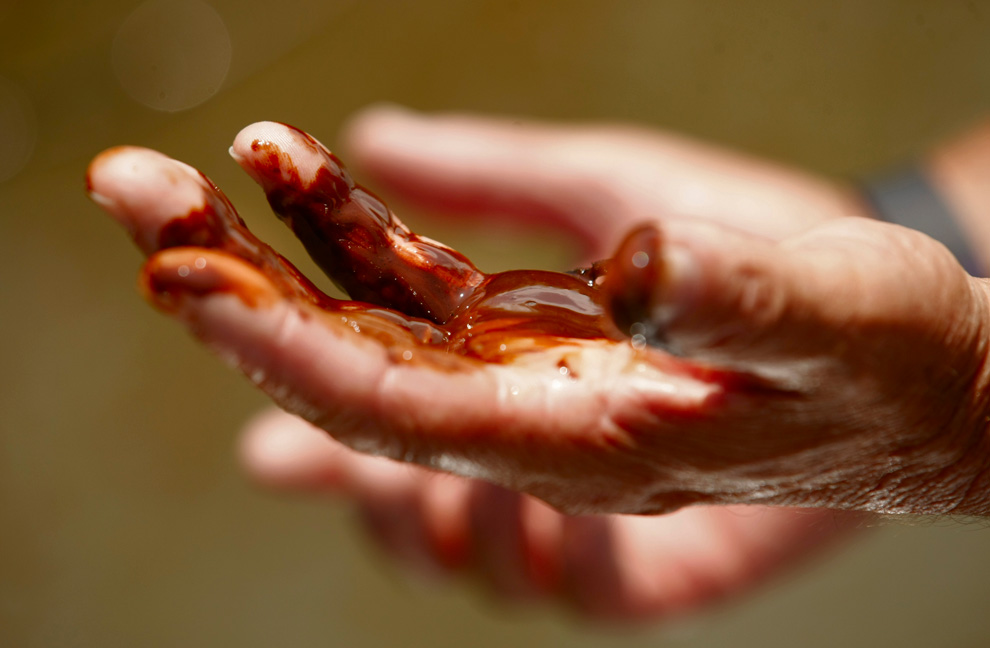
Worth noting that when I posted this on June 2nd, the low end was set to about 500,000 gallons leaked each day, and that estimated amount (the low end) has now tripled. And in the last few days, pretty much all the information I have been able to gather and discover tends to indicate that the good ol' US of A is poised most precariously over an abyss and the ultimate damage is going to be far beyond catastrophic and we may soon call the Gulf of Mexico the Gulf of Doom. (For more on the photo shown above, see Southern Beale.)
Sadly, only recently have news and other agencies begun to report what was being reported on your Cup of Joe back in May -- BP knew how unstable the geologic structure of the seabed they were drilling was, that leaks were prominent before the explosion, that officials with BP and Transocean and Halliburton all knew the interior well casings located thousands of feet below the seabed itself were improperly made and not working ... and really, all that info came from the interview on "60 Minutes" which aired May 16th:
"The tension in every drilling operation is between doing things safely and doing them fast; time is money and this job was costing BP a million dollars a day. But Williams says there was trouble from the start - getting to the oil was taking too long.
Williams said they were told it would take 21 days; according to him, it actually took six weeks. With the schedule slipping, Williams says a BP manager ordered a faster pace. "And he requested to the driller, 'Hey, let's bump it up. Let's bump it up.' And what he was talking about there is he's bumping up the rate of penetration. How fast the drill bit is going down," Williams said.
Williams says going faster caused the bottom of the well to split open, swallowing tools and that drilling fluid called "mud."
"We actually got stuck. And we got stuck so bad we had to send tools down into the drill pipe and sever the pipe," Williams explained. That well was abandoned and Deepwater Horizon had to drill a new route to the oil. It cost BP more than two weeks and millions of dollars. "We were informed of this during one of the safety meetings, that somewhere in the neighborhood of $25 million was lost in bottom hole assembly and 'mud.' And you always kind of knew that in the back of your mind when they start throwing these big numbers around that there was gonna be a push coming, you know? A push to pick up production and pick up the pace," Williams said.
Asked if there was pressure on the crew after this happened, Williams told Pelley, "There's always pressure, but yes, the pressure was increased." But the trouble was just beginning: when drilling resumed, Williams says there was an accident on the rig that has not been reported before. He says, four weeks before the explosion, the rig's most vital piece of safety equipment was damaged."
The only hopeful note I can detect in this mad symphony is that perhaps one or both of the two relief wells being made which seek to connect with the escaping oil -- perhaps by the end of August, perhaps much later. And no guarantees. The Worst Case Scenarios that are now playing in the Gulf are too terrible to even consider ... and truth is, I sense no one involved really can say just how badly BP screwed up here - if the seabed above the current well collapses ...
Worth noting too is just how much methane gas is pouring into the ocean as well, up to 40% of the spill is made of methane, compared to a 5% level normally found in oil deposits.
"The question is what's going on in the deeper, colder parts of the ocean," he said. "Are the (methane) concentrations going to overcome the amount of available oxygen? We want to make sure we're not overloading the system."
BP spokesman Mark Proegler disputed Joye's suggestion that the Gulf's deep waters contain large amounts of methane, noting that water samples taken by BP and federal agencies have shown minimal underwater oil outside the spill's vicinity.
"The gas that escapes, what we don't flare, goes up to the surface and is gone," he said.
It appears that comment means an unknown quantity of methane gas is (daily) venting out over the surface of the Gulf. And people have become suddenly ill working in the region ....
I continue to wonder what horrifying tipping point is needed to push this nation into a total retreat from Fossil Oil Addiction - elected officials have trotted out enough empty words about "Energy Independence" for decades and still our science and our politics clings to the technologies of the 19th century.
SEE ALSO:
TVA abandons Green Power programs
The Solar Energy Industries Association (SEIA), says industry-wide goal of installing 10 gigawatts of solar capacity annually by 2015 expected. " The leaders of the solar industry have set this target to show Americans that solar can and will become the nation’s largest source of new electricity generation by 2013. We are already cost competitive with fossil fuels, and by 2015 we expect solar energy to be the lowest cost source of retail electricity in all fifty states. But to reach our goal, we need to ensure that effective policy mechanisms are in place to give consumers the choice to go solar – a choice more than 90 percent of Americans support.
Sunday, June 13, 2010
Sen. Alexander Says You Are Not Grown Up Enough to Understand Energy Policies
Senator Lamar Alexander spoke out this week on U.S. Energy issues and policies, and it's a fine example of "sound and fury signifying nothing". One East TN newspaper, The Daily Times thinks his ideas are sheer genius.
Sen. Alexander made his thoughts known on the floor of the Senate chamber, ideas he called "steps for Grown Ups". It's a mish-mash of nifty talking points, prompted by the massive destruction created by the BP oil gusher currently turning the Gulf of Mexico into a dead zone, and they really fall apart under scrutiny. (The Notes cited below are mine, not the Senators.)
1 - Figure out what went wrong and make it unlikely to happen again. We don’t stop flying after a terrible airplane crash, and we won’t stop drilling offshore after this terrible spill. Thirty percent of U.S. oil production (and 25 percent of natural gas) comes from thousands of active wells in the Gulf of Mexico. Without it, gasoline prices would skyrocket and we would depend more on tankers from the Middle East with worse safety records than American offshore drillers.
NOTE: Someone should notify the senator we know what went wrong in the BP disaster, as the company faked records detailing safety plans, moved too fast, and ignored warnings from workers on the rig itself. And those tanker spills He bemoans do not match the facts - "Thus, it is apparent from the table below that the number of large spills (>700 tonnes) has decreased significantly during the last 40 years, such that the average number of major spills for the decade (2000-2009) is about three. Most notably, for the first time since ITOPF began collating tanker spill statistics, the number of major oil spills involving tankers reached zero in 2009.
The average for the 2000s is less than half of the average for the 1990s and just an eighth of the average for the 1970s. The same is true for medium sized spills from tankers (7-700 tonnes) where the average number of spills occurring in the last decade was 14, half of that experienced during the previous decade."
2 - Learn a safety lesson from the U.S. nuclear industry: accountability. For 60 years, reactors on U.S. Navy ships have operated without killing one sailor. Why? The career of the ship’s commander can be ended by a mistake. (The number of deaths from nuclear accidents at U.S. commercial reactors is also zero.
NOTE: A reactor aboard a ships would never create the amount of destruction of a nuclear power plant on land. Plans now exist to start establishing seven floating nuke plants off Russian coastlines. Of course, I am sure their safety measures are beyond reproach (cough, cough).
3 - What was the president’s cleanup plan and where were the people and equipment to implement it? In 1990, after the Exxon Valdez spill, a new law required that the president “ensure” the cleanup of a spill and have the people and equipment to do it. President Obama effectively delegated this job to the spiller. Is that a president’s only real option today? If so, what should future presidents have on hand for backup if the spiller can’t perform?
NOTE: Senator, the real question for grown ups is what was BP's plan, where was their equipment? Should Americans expect the President, whomever that might be, to be the the point man on massive industrial disasters? What are the plans for ALL the corporations now engaged in offshore drilling to address disastrous events?
4 - Put back on the table more on-shore resources for oil and natural gas. Drilling in a few thousand acres along the edge of the 19-million-acre Alaska National Wildlife Refuge and at other on-shore locations would produce vast oil supplies. A spill on land could be contained much more easily than one mile deep in water.
NOTE: The Prudhoe Bay pipeline spill in Alaska in 2006 (an operation headed by BP, of course, took place despite 8 years of warnings. Press reports at the time said "another black eye to a firm that has fashioned an image as a responsible, environmentally concerned company, and it drew new criticism from pipeline experts and environmentalists who have been saying for years that the company had failed to do the maintenance needed to keep the pipeline free from sludge and protect it from corrosion in the harsh Alaska conditions. The Environmental Protection Agency has launched a criminal probe to determine whether the company was negligent in managing the pipeline, said sources who had talked to government investigators. However, then President Bush shut down the criminal investigation by the Department of Justice.
5. Electrify half our cars and trucks. This is ambitious, but is the best way to reduce U.S. oil consumption, cutting it by one-third, to about 13 million barrels a day. And a Brookings Institution study says we could electrify half our cars and trucks without building one new power plant if we plug in our cars at night.
7. Stop pretending wind power has anything to do with reducing America’s dependence on oil. Windmills generate electricity — not transportation fuel. Wind has become the energy hula hoop of the 21st century and a taxpayer rip-off. According to the Energy Information Administration, wind produces only 1.3 percent of U.S. electricity but receives federal taxpayer subsidies 25 times as much per megawatt hour as subsidies for all other forms of electricity production combined. Wind can be an energy supplement, but it has nothing to do with ending our dependence on oil.
NOTE: I'll let The New Republic answer the senator on those topics -- " ... if half our cars are electric, then electricity would be transportation fuel. Still with me? No? Okay, I'll break it down. The wind would turn the windmills round and round. This would generate electricity, which would be sent to people's houses through wires. The electricity could then be used to run electric cars.
This is not the only problem with Alexander's piece. He outlines goals, like increasing conservation and electrifying half the automobile fleet -- but he has absolutely nothing about how to obtain these goals. His electric car plan is literally what you read above: "Electrify half our cars and trucks." Who would do this? How? He does not say. Cars and trucks run on gasoline because gasoline is the cheapest fuel available. If you wanted half the cars to run on electric power, you'd have to change this so that gasoline was no longer the cheapest fuel available. It could be a tax on carbon emissions, enormous subsidies for electric batteries, regulatory fiat, something. Likewise, if you want people to conserve energy, you need to increase the cost of using energy.
I'm not sure how you have a debate with people like this."
"What a great idea! Kevin Drum explained, "There's just gotta be something we can do with all that CO2! I dunno. Freeze it and sell it to Spinal Tap for their live shows? Mount a campaign to increase soda sales a hundred million percent? Build a time machine and then hire some alchemists to figure out how to turn it into liquid gold? Honest to God, where does this stuff come from?
Remember, Lamar Alexander is not only supposed to be one of the more responsible members of the Senate Republican caucus, but the piece was labeled, "An Energy Strategy for Grown-Ups."
Grown-ups who don't really understand energy policy and brush over inconvenient details, perhaps?"
8. If we need more green electricity, build nuclear plants. The 100 commercial nuclear plants we already have produce 70 percent of our pollution-free, carbon-free electricity. Yet the U.S. has not broken ground on a new reactor in 30 years, while China starts one every three months and France is 80 percent nuclear. We wouldn’t put our nuclear Navy in mothballs if we were going to war. We shouldn’t put our nuclear plants in mothballs if we want low-cost, reliable green energy.
NOTE: I like how the senator says "IF we need more green electricity ..." which clearly shows he considers TVA customers as quaintly confused thinkers. Also, the massive costs of building new nuclear plans is so large, it would likely triple the rate of current U.S. utility rates. Which is simply more proof that Sen. Alexander's 'grown up' ideas are fine examples of meaningless blather. Honesty and tough decisions lay ahead of us, and the senator's suggestions offer no real solutions.9. Focus on conservation. The Tennessee Valley Authority could close four of its dirtiest coal plants if the region reduced its per capita use of electricity to the national average.
NOTE: IN other words, it is YOUR fault, Tennessee, for needing electricity. And just what Mr. Senator have you done to address the horrible destruction from TVA in Roane County's toxic ash spill??
10. Make sure liability limits are appropriate for spill damage. The Oil Spill Liability Trust Fund, funded by a per-barrel fee on industry, should be adjusted to pay for cleanup and to compensate those hurt by spills. An industry insurance program like that of the nuclear industry is also an attractive model to consider.
Wednesday, June 02, 2010
Coming Apart At Every Nail, or The BP Deepsh*t Disaster
Given the constant failure of "blowout preventers" in offshore oil wells, and a lack of technology to create reliable fail-safe methods of capping an endlessly oil spewing mess, one simple and very old tactic almost always works.
It's a relief well, just like the two being drilled now in the Gulf of Mexico. Some online folks began talking last week about how Canada requires oil companies to create a relief well for all offshore drilling before said companies are allowed to drill.
Except that is not quite true and even today, BP is pushing Canada to drop that requirement, citing the costs involved.
"• Canadian regulations about relief wells are not quite as simple as the Reuters story suggested. • Oil companies do not actually have to drill relief wells in advance. Rather, in order to get a drilling permit they have to satisfy the National Energy Board that they have the capability to drill a relief well the same season as the exploratory well.
---
"In 2008, BP paid C$1.2 billion ($1.8 billion) for rights to explore three parcels in Canada's Beaufort Sea, north of the Arctic Circle.
It has yet to announce plans to drill in the region but shortly before the U.S. disaster, BP and other oil companies urged Canadian regulators to drop a requirement stipulating that companies operating in the Arctic had to drill relief wells in the same season as the primary well."
So many who previously moaned about the intrusion of government now see government as superhero.
Confusion grows in times like these. Getting information is important, but a recent transcript of a Q and A with reporters and Coast Guard Admiral Thad Allen offers mostly confusion.
"Q: (Inaudible) - (inaudible) (expect that 2,000 acres to fill in), but it's more like 30 acres, do you have any updates on that and how (inaudible)?
ADM. ALLEN: We're beginning conversation of what I would call linear versus top (inaudible). And I think probably the best thing for us to do is - (inaudible) - folks a couple of days to - sit down and come up with a (inaudible) (metric). (Inaudible) - miles of shoreline doesn't necessarily equate the impact you're looking at with the half-mile in the marsh. And I understand the difference there and we will reconcile - (inaudible).
And today I read where the underwater robots bedecked with diamond-edged saws which BP is using to try and cut off part of the leaking pipe so they can contain some of the spill is stuck in the pipe.
Sunday, May 30, 2010
Yearly Spill Larger Than Gulf Oil Disaster
"In fact, more oil is spilled from the delta's network of terminals, pipes, pumping stations and oil platforms every year than has been lost in the Gulf of Mexico, the site of a major ecological catastrophe caused by oil that has poured from a leak triggered by the explosion that wrecked BP's Deepwater Horizon rig last month.
That disaster, which claimed the lives of 11 rig workers, has made headlines round the world. By contrast, little information has emerged about the damage inflicted on the Niger delta. Yet the destruction there provides us with a far more accurate picture of the price we have to pay for drilling oil today."
---
"With 606 oilfields, the Niger delta supplies 40% of all the crude the United States imports and is the world capital of oil pollution. Life expectancy in its rural communities, half of which have no access to clean water, has fallen to little more than 40 years over the past two generations. Locals blame the oil that pollutes their land and can scarcely believe the contrast with the steps taken by BP and the US government to try to stop the Gulf oil leak and to protect the Louisiana shoreline from pollution."
Oh, and those "blowout preventers" are famous for failing on a constant basis, and officials lied to cover it up.
Tuesday, May 25, 2010
The Oil War in The Gulf of Mexico
"In fact, there are three fronts. We’ve got the emissions at the bottom of the ocean. We have where the oil is coming to the surface and trying to fight it as far offshore as we can -- you’d rather deal with it there before it even gets close to shore -- and then how you deal when it makes contact with shore. And the three kind of distinct operations require different sets of -- types of capability. And we’re fighting a three-front war basically at once."
That's from Admiral Thad Allen, recently retired from the Coast Guard, and the government's point man on the disastrous and non-stop gusher of oil in the deepwaters of the Gulf of Mexico. KnoxViews has more from Adm. Allen's comments yesterday.
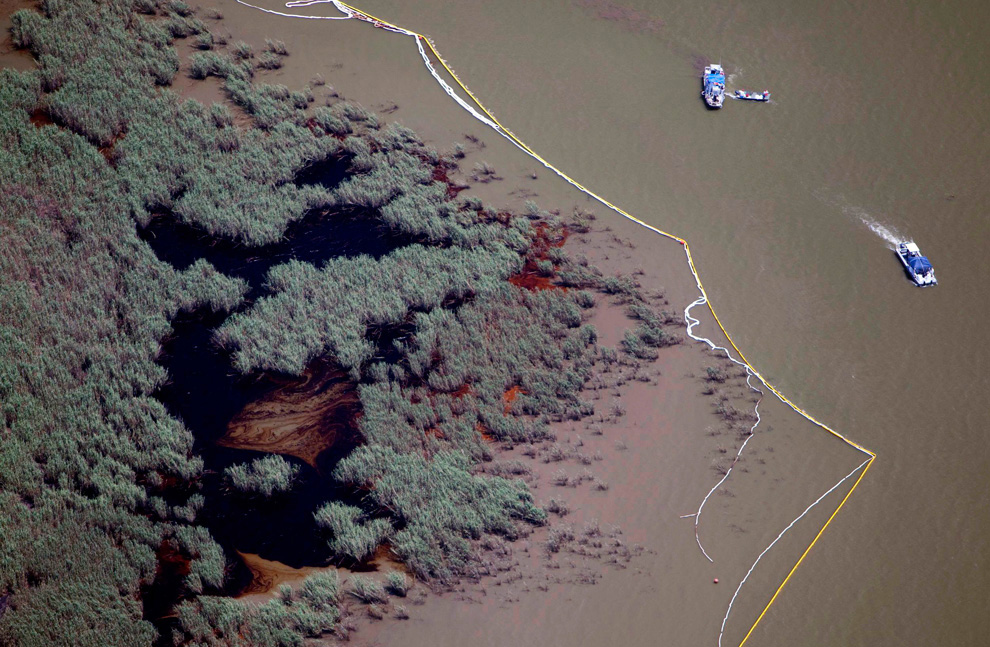
Above that quote, one of several jaw-dropping images featured on The Big Picture. The ever-growing pollution and environmental destruction is hitting the smallest and the largest lifeforms across the region. Here are some other pics from the web site. Click on the images to see them in larger formats, or just click on the link above to The Big Picture.
Monday, May 17, 2010
The Deepwater Disaster Was Preventable
Mike Williams' story also details how the massive and unprecedented disaster which continues today to endanger the entire Gulf and likely beyond it could have been prevented, if only those in charge had paid attention to the critical mistakes which BP and Transocean made in the days and weeks before the explosion.
"Down near the seabed is the blowout preventer, or BOP. It's used to seal the well shut in order to test the pressure and integrity of the well, and, in case of a blowout, it's the crew's only hope. A key component is a rubber gasket at the top called an "annular," which can close tightly around the drill pipe.
Williams says, during a test, they closed the gasket. But while it was shut tight, a crewman on deck accidentally nudged a joystick, applying hundreds of thousands of pounds of force, and moving 15 feet of drill pipe through the closed blowout preventer. Later, a man monitoring drilling fluid rising to the top made a troubling find.
"He discovered chunks of rubber in the drilling fluid. He thought it was important enough to gather this double handful of chunks of rubber and bring them into the driller shack. I recall asking the supervisor if this was out of the ordinary. And he says, 'Oh, it's no big deal.' And I thought, 'How can it be not a big deal? There's chunks of our seal now missing?"
The utter damage and destruction is flowing even as I write, and even if the enormous flood of crude oil were to be stopped at this very moment, the devastation and effects will be felt for at least a decade -- or even longer.
Driven by greed and ego, both the businesses and the MMS government officials who sanctioned the work have dealt a crippling blow to our nation and our world, from microbes upwards to nearly every form of life in the region. The Center For Public Integrity reveals that BP has willfully ignored and violated safety plans, that the problem is systemic, and despite efforts of some in government and over $90 million in fines, dozens of lives lost in fiery infernos, the company continues on a path which endangers us all.
"Refinery inspection data obtained by the Center under the Freedom of Information Act for OSHA’s nationwide program and for the parallel Texas City inspection show that BP received a total of 862 citations between June 2007 and February 2010 for alleged violations at its refineries in Texas City and Toledo, Ohio.
"Of those, 760 were classified as 'egregious willful' and 69 were classified as 'willful.' Thirty of the BP citations were deemed “serious” and three were unclassified. Virtually all of the citations were for alleged violations of OSHA’s process safety management standard, a sweeping rule governing everything from storage of flammable liquids to emergency shutdown systems. BP accounted for 829 of the 851 willful violations among all refiners cited by OSHA during the period analyzed by the Center."
UPDATE: Speak To Power compares the disaster in the Gulf to another episode of worldwide destruction and the people who simply have no choice but to wait and see what happens. That's a real definition of horror.
Sunday, May 02, 2010
No End In Sight For Massive Oil Leak in Gulf
"The Gulf of Mexico oil spill may be growing five times faster than previously estimated and is in danger of accelerating out of control, it was claimed yesterday.
Experts said satellite data indicated the oil was gushing from BP’s sunken Deepwater Horizon rig at 25,000 barrels a day. Previous estimates had put the leak at 5,000 barrels a day.
Professor Ian MacDonald, an ocean specialist at Florida State University, said the new estimate suggested the leak had already spread 9m gallons of heavy crude oil across the Gulf. This compares with 11m that leaked from the Exxon Valdez tanker when it hit a reef off Alaska in 1989.
The National Oceanic and Atmospheric Administration said deteriorating conditions on the sea bed may result in an even greater flow of 50,000 barrels a day, sufficient to produce one of America’s worst ecological disasters.
Experts and officials said their greatest fear was that a disintegration of pipes close to the rig could produce an “unchecked gusher” that would ravage America’s southern coastline.
As the slick slowly drifted towards fragile shorelines from Louisiana to Florida, there was intensified criticism of BP for apparently underestimating the potential scale of the disaster.
The British oil giant faces questions over how much it knew about previous problems with “blowout preventers”, the giant underwater valves designed to shut down oil flow in the event of accidents.
The valves on the rig failed to work after it exploded on April 20. BP technicians have been unable to activate them even though they appear to be undamaged by the blast.
BP has calculated that it might take up to three months to sink a new well that could cut off the flow of the Deepwater Horizon’s oil.
The worst oil spill affecting US waters was caused by a 1979 blowout aboard the Ixtoc, a Mexican rig that discharged at least 130m gallons, 600 miles south of the Texas coast. It took nine months to plug the leak.
Monday, June 29, 2009
TVA and The Real Cost of Burning Coal
"Some of TVA's oldest, dirtiest and least efficient coal units should have been phased out years ago and replaced with renewable power," said Stephen Smith, executive director for the Southern Alliance for Clean Energy and a former member of TVA's Regional Resource Stewardship Council.
Matt Landon, a volunteer leader of a 4-year-old group fighting against coal usage in East Tennessee -- United Mountain Defense -- blames coal plants for much of Tennessee's air pollution.
"From the cradle to the grave, coal is dirty and destroys our environment," said Mr. Landon, who was arrested by TVA police in March for trespassing on the site of a major ash spill in Kingston.
In its 76-year history, TVA has shut down only one coal plant -- the former Watts Bar Steam Plant in Rhea County. But TVA officials said the agency also is studying whether it still makes sense to maintain and upgrade its oldest plants, including units in Johnsonville and Widows Creek which already are senior citizen age.A federal judge has ordered TVA to install scrubbers on the six oldest units at its Widows Creek Fossil Plant near Stevenson, Ala., within the next five years. Mr. Kilgore said the agency is now studying the costs of installing the court-ordered pollution controls. To recover such an investment, the units normally would be expected to operate for at least another two decades."
Meanwhile, state officials and the TDEC want more transparency on how coal and coal ash are handled in Tennessee:"Following the catastrophic failure of the TVA Kingston Plant coal ash impoundment on Dec. 22, 2008, the U.S. Environmental Protection Agency reviewed coal ash impoundments across the country.
"The U.S. Army Corps of Engineers has apparently requested the results of that review not be made available to the public. Irrespective of the Corps' recommendations regarding nationwide sites, the Tennessee Department of Environment and Conservation believes transparency is important and is committed to sharing results of our own state review with the public.When Gov. Phil Bredesen visited Kingston shortly after the failure, he stressed the need for transparency in the monitoring and cleanup to help assure citizens what appropriate steps were being taken to protect public health and minimize environmental impacts of the failure. Among other directives, he asked the department to begin immediately posting results of water, air and soil testing online so the public could access information easily and directly."
We're stuck on coal. Not clean coal or green energy - just plain old coal, same as we were decades ago.